Get London Transfer Ltd is a TfL licensed private hire operator - London private hire operator licence number 11588. getlondontransfer.co.uk and rushxo.com are trading names of Get London Transfer Ltd, and rushxo.co.uk is the UK site of rushxo.com. Every booking made on these websites is operated by Get London Transfer Ltd.
Gatwick → Guildford · Flight-Tracked · Either Terminal · Fixed Fare
Gatwick to Guildford taxi — 40 to 50 minutes, fixed fare, met in arrivals
Gatwick to Guildford is about 25 to 27 miles and takes 40 to 50 minutes by taxi to your door, often quicker for evening and night arrivals. The direct train runs hourly and thins out in the evening, so late landings are where a pre-booked, fixed-fare car earns its keep; your driver meets you at either terminal and waits if your flight is late.
Landing at Gatwick Airport? Let us take the stress off
Your driver is waiting with a name board the moment you come through customs into arrivals – not in a car park, not on the phone. We track the flight, so a late landing costs you nothing, and the first 60 minutes after the plane lands are free waiting time. Luggage trolleys, a child seat, a wheelchair-friendly car: tell us when you book and it is ready.
SIM card and money on the way. Still carrying your own currency? That is fine: every car takes cards and contactless, so you need no pounds in hand for the journey. If you want a UK SIM or some cash, say so and your driver will point you to the kiosks in arrivals (SIM cards: WHSmith and Sim Local in both terminals’ arrivals; currency: Travelex / Moneycorp desks landside in North and South) or, usually cheaper, stop at a supermarket, Post Office or bank on the route to Guildford. Our local drivers know where the fair rates and the working cash machines are – trust them to sort it in minutes.
Disabled-friendly arrival.Special assistance: Book via airline at least 48h ahead; Assisted Travel receptions at drop-off points, help points at bus stops, entrances, Short Stay car parks, check-in, pre-security and departure lounge; Eagle Hoist with 24h notice. Step-free: Most gates via airbridges; Ambulift where stairs; lifts to station platforms; Premium car parks same-level access. Guide & assistance dogs: Only assistance dogs allowed in terminals; notify airline 48h; Service Animal Spend Area via the Assisted Travel team. Pets: Dogs flying must meet the PETS scheme. Airport accessibility page Our driver meets you at the assistance desk if you prefer, carries folding wheelchairs and walkers free, and assistance dogs always travel with you at no charge.
Get an Instant Quote
🦉Tripadvisor Travelers' Choice 2025Excellent★★★★★★ Trusted24/7 UK Support
Coming home to Surrey has a timing problem nobody warns you about: the returning holiday flights that define Gatwick's evenings are exactly the ones that slip — and the direct train to Guildford runs hourly with an evening horizon, so a charter that lands at half past eleven steps into a station going quiet. This run is built for that reality. Your flight is followed from the moment it leaves the tarmac abroad; a driver stands in the correct terminal's arrivals hall — North or South, no shuttle first — holding your name; and the road home, orbital or Downs, is chosen from live conditions while you're still watching the carousel. Fixed fare, any hour, every lane from Stag Hill to the Hills. The holiday ends at your door, not at a timetable's.
The railway's day ends; the desk's doesn't — the difference every late charter discovers.
The Late-Landing Gap · The Problem This Page Exists For
When your charter slips past the railway's bedtime
The outbound comparison flatters the train; the homeward one exposes it. Gatwick's evening arrivals board is a study in slippage — and an hourly service with an evening horizon is precisely the wrong safety net for it.
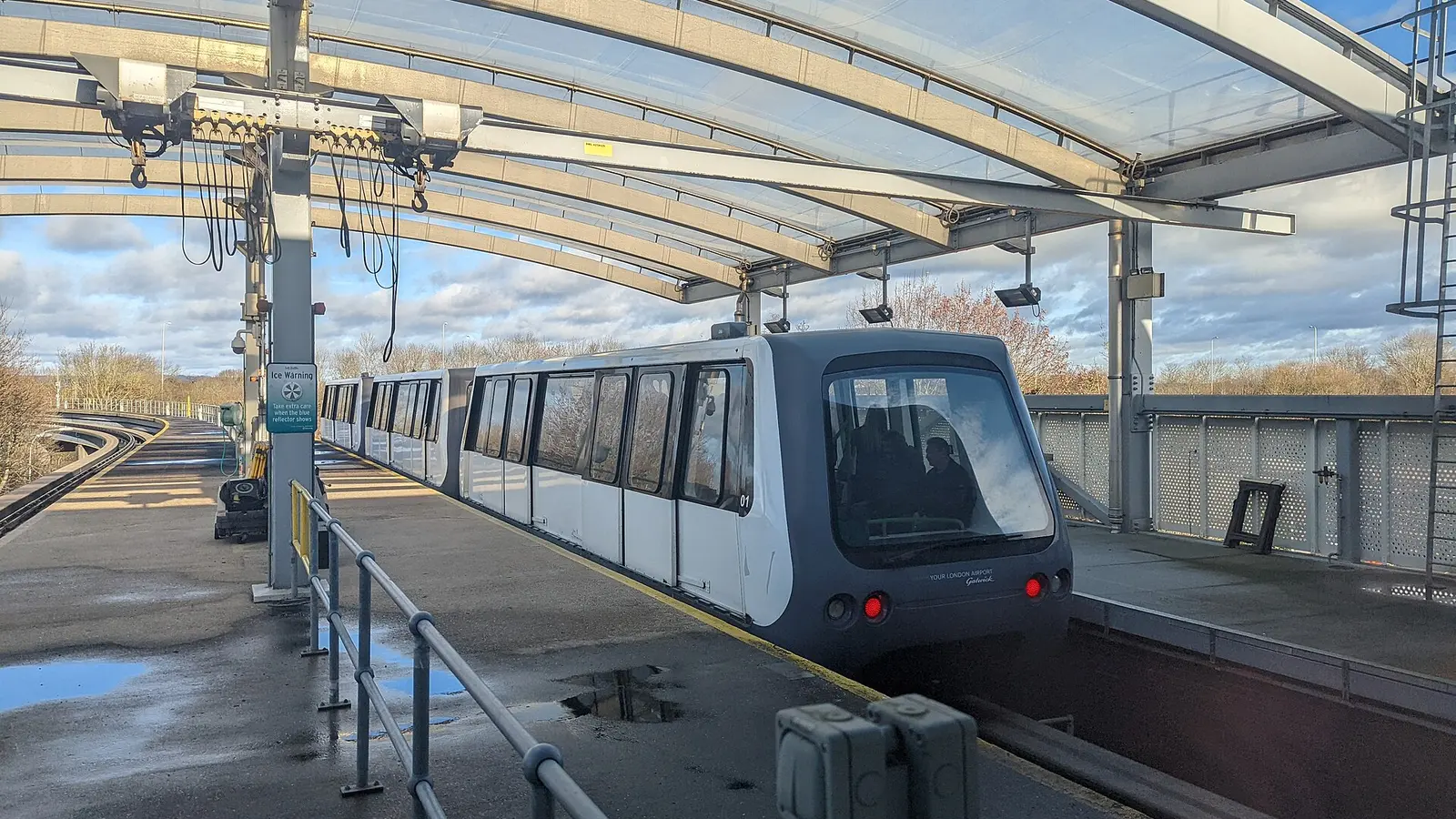
Gatwick Airport · Photo: David Wheatley, CC BY-SA 4.0 via Wikimedia Commons
The homeward scenario
What the timetable offers
What actually happens
The Med charter due 22:40
A late direct service — if the flight is punctual
Forty minutes of slip, a slow carousel, and the platform option has thinned to hoping — with a family and a trolley in tow
The delayed city-hop, in at 00:30
Nothing useful until morning
The station-side choices are a night bus puzzle or surge-priced roulette; the pre-booked car is simply standing in arrivals
The North Terminal landing
The railway waits on the South side
Shuttle first, cases in hand, before the train part even begins — the asterisk nobody reads until they're living it
The hourly cadence, missed
The next service, sixty minutes away
A slow passport queue is all it takes; the hour is then spent on a platform instead of the A3
Any landing, any hour, tracked
—
Our version: the car re-times itself to your true arrival, meets the hall you actually exit, and drives — no cadence, no horizon, no asterisk
The principle underneath: a timetable serves the airport's schedule; a tracked booking serves your flight. On a corridor where the marquee arrivals are evening charters famous for running late, that distinction isn't philosophy — it's whether you're home by midnight or negotiating a forecourt at one. We built the homeward run on the tracking, and the rest of this page follows from it.
The Road Home · Decided While You Queue
Orbital or Downs — the homeward choice, made before you've found your bags
The two-road advantage runs both directions, but homeward it wears night colours: by the time most Guildford arrivals land, the roads have changed character entirely from the morning the internet's estimates describe.
HOME / VIA ORBITAL
M23 up, round to the A3
The night default: up the M23, anticlockwise past the Reigate junctions to Wisley, and down the A3 into town. After nine in the evening this is a flowing, unbothered run — the quadrant that terrorises the daytime is a different road entirely by the time the charters land, and the miles pass at motorway pace all the way to your exit.
HOME / VIA THE DOWNS
Reigate, Dorking, the A25 west
The insurance policy: when an overnight closure, an incident or daytime congestion argues with the orbital, the old road through the Downs villages carries you home instead — shorter in miles, steady in temperament, and driven by people who know its bends rather than discovering them. Your driver commits while you're still at reclaim, from conditions, not habit.
What it means for your evening: homeward runs routinely beat the daytime estimates — 40 minutes to a town address off a late flight is normal, the villages a few minutes more. And because the fare was fixed at booking, the road chosen is purely the fastest safe one, never the one that pads a meter. You doze; the decision's handled.
Real Problems · Real Fixes
Where the journey home from Gatwick breaks — and the repairs built in
Homeward failures have their own shapes, different from departure ones. These six are the corridor's regulars, each met before your plane boards abroad.
RISK / 01
The arrival after the timetable
The problem: the classic Gatwick evening — a charter due at eleven landing past midnight — arriving into a station whose useful services have finished and a forecourt running on surge maths. Our fix: the desk has no closing time; the booking was made for whatever hour you'd actually land, and the tracking meant we knew before you did.
RISK / 02
The shuttle before the journey
The problem: landing at North Terminal and discovering the railway lives on the South side — a transit ride with a loaded trolley inserted before the "direct" train even starts. Our fix: the name board stands in the hall you exit, whichever terminal that is; the journey begins at your first step into arrivals.
RISK / 03
The reclaim-hour gamble
The problem: planning a train around a landing time, then losing the connection to a slow passport queue or a stubborn carousel — the hourly cadence turning twenty lost minutes into eighty. Our fix: the car has no cadence to miss; it waits on you, with free waiting absorbing the airport's own delays.
RISK / 04
The lane no stranger can find
The problem: an out-of-area driver hunting an unlit Shalford close or a Hills track at 1am, sat-nav confidently wrong, your phone at two percent. Our fix: drivers who finish in these villages weekly — the last dark mile navigated from knowledge, not hope.
RISK / 05
The family maths at midnight
The problem: four rail fares plus a station-to-village cab at night quietly exceeding one fixed car fare — a discovery made standing tired on a platform. Our fix: the arithmetic done at booking: one right-sized vehicle, one price, everyone and the luggage delivered together to the true door.
RISK / 06
The return nobody booked
The problem: an outbound arranged carefully while the homeward leg is left to "we'll sort it there" — the leg most likely to land late, at night, with the least energy to improvise. Our fix: book both directions in one message; the return inherits the tracking, the fixed fare and the name board automatically.
Where the Run Ends
The Surrey doorsteps this road delivers to
DROP / A
Town, terrace & the campus
Guildford's own streets, the High Street hotels, and Stag Hill's halls for students returning from term breaks and Europe's budget network — dropped building-exact, with September's arrival waves and the term's homecomings a standing rhythm.
DROP / B
Godalming, Shalford & the closes
The village endings that make this run what it is: the lanes and cul-de-sacs where the railway never went and night navigation defeats visitors — finished from memory, cases to the gate, at whatever hour the flight decided.
DROP / C
The Hills hotels & the gardens
Visitors bound for the Surrey Hills' country hotels, wedding venues and walking bases — and RHS Wisley's neighbourhood on the way past — delivered as the first calm leg of a Surrey stay rather than a navigation exercise.
DROP / D
Merrow, Burpham & the returns
The eastern neighbourhoods' homecoming families, Royal Surrey staff off shift-and-fly rotations, and the relatives collected on behalf of hosts — the everyday endings of a county town's travel, each on its fixed fare.
View from an aircraft window above the clouds
Your Rights · Trust at the Arrivals Door
Why the licensed name board beats every stranger at the barrier
Arrivals halls are where tired judgement meets confident strangers. The licensing framework exists for exactly this moment — here's what separates our name board from the voices at the barrier.
What's behind the board
A journey that pre-exists you landing: the law permits private hire only on an operator's logged booking — the car meeting you was committed, driver named, before your flight left abroad. The barrier's improvisers can't say that.
Identity checked upstream: operator licence, driver vetting, vehicle inspection — three verifications completed long before the hall, none of them yours to perform at midnight.
Cover that's genuinely in force: the passenger insurance of a lawful booking rides the whole way home — the invisible difference between a licensed car and an eager offer.
What it spares you
The negotiation: your fare was fixed when you booked from the sofa, not debated at a kerb with your luggage as leverage.
The uncertainty: a 24/7 desk that watched your flight and knows your booking — a call away if anything about the night shifts.
The anonymity: a licensed firm's name on the job, findable tomorrow — accountability the arrivals-hall freelancer structurally cannot offer.
The homeward rule of thumb: at midnight, tired, abroad-lagged and luggage-laden, the only offers worth accepting are the ones that existed before you landed. That's what pre-booked and licensed means in practice — and it's the whole reason the name board works.
Straight Answers
Gatwick to Guildford taxi — the questions, answered properly
How quick is the homeward run to Guildford?
The 25-to-27-mile run home usually lands between 40 and 50 minutes — and often beats it, because most Guildford arrivals land in the evening when both roads empty out. Your driver picks between the M23-and-orbital route and the Downs road through Reigate and Dorking from live conditions while you're still at reclaim, so an overnight closure or incident costs a detour, not an ordeal. Villages add a few minutes past town; the fare, fixed at booking, doesn't move either way.
My flight is due at 23:20 and these charters always run late — what happens?
Exactly what the service was built for. We track the aircraft from its departure airport, so the slip is on our screen before you've boarded; the pickup re-times itself to the true landing, free waiting covers the airport's own delays, and the driver enters the hall for when you actually emerge. Meanwhile the hourly train's evening horizon has passed and the forecourt is running surge arithmetic — the comparison at midnight isn't close. We operate around the clock: there is no arrival we call too late.
Where exactly will I find the driver?
Inside the arrivals hall of your terminal — North or South, whichever your flight uses — holding a board with your name. No shuttle to the other terminal first (the railway's quiet catch, since the station sits on the South side), no car-park pin-hunt, no timed message exchange. You clear the doors, you see your name, the cases leave your hands. For meet-and-greet at busy charter hours the board is the whole system, and it works precisely because it's simple.
Can you drop us in Godalming or the Hills lanes after midnight?
Weekly, and happily — the villages are this run's natural endings. Our drivers finish in Shalford's closes, Compton's lanes and the Hills' unlit tracks often enough to navigate them from memory, which at 1am with a sleeping car matters more than any app rating. The fare is quoted to the true door at booking, the hour changes nothing, and the last dark mile is part of the service rather than an adventure appended to it.
Should I book the return together with my outbound?
It's the single best habit on this corridor. One message with both flights locks both legs: the outbound timed to your cutoff, the return inheriting the tracking, the fixed fare and the name board automatically — so the leg most likely to land late, at night, with your energy spent, is the one already handled. Send both flight numbers via WhatsApp, phone or email and the round trip is done in one confirmation.
Do you run the outbound and the Heathrow legs as well?
All of them, daily. The departure side — the two roads weighed, the train credited honestly, the cutoff sum — lives on our Guildford to Gatwick taxi page; the other airport is covered by our Heathrow to Guildford and Guildford to Heathrow guides with published fixed prices from £107. One desk, every leg, 24/7.
Making the Most of Your Journey: Stops & Sightseeing
Eat & shop like a Londoner: fish & chips, roast, afternoon tea, pies, ale, vegan, British brands – with prices (tap to open)
Eat and shop like a Londoner: fish & chips, Sunday roast, full English, afternoon tea, pies, pale ale, vegan & the best British brands
Our drivers get asked for these every day, so here is the shortlist we give in the car. Prices are from the venues’ own menus and booking sites (seen October 2026); tap the Google Maps link for photos, today’s menu and star ratings. Want a stop on the way? Say so when you book and the driver will wait.
Fish & chips
Poppies Fish & Chips Spitalfields E1, Soho W1, Camden NW1, Portobello W11 1950s East End chippy, haddock and cod fried to order, mushy peas cod & chips £21.99, haddock £20.99 (menu) website · photos, menu & ratings on Google Maps
Golden Union Poland St, Soho W1 Proper chippy with a sit-down room, gluten-free batter on request about £15–£19 for fish and chips website · photos, menu & ratings on Google Maps
Sunday roast
Hawksmoor Seven Dials WC2, Borough SE1, Air Street W1, Wood Wharf E14, Knightsbridge The roast most Londoners name first: dry-aged rump, beef-dripping roast potatoes, Yorkshire pudding Sunday roast rump £29.50 (menu); book ahead website · photos, menu & ratings on Google Maps
Blacklock Soho W1, Shoreditch EC2, Covent Garden WC2, Canary Wharf E14 Chop-house roasts with all the trimmings and bottomless gravy roast about £24–£28 (menu) website · photos, menu & ratings on Google Maps
English breakfast
E Pellicci 332 Bethnal Green Rd E2 Family caff since 1900, Art Deco interior, fry-ups and Italian specials; cash-friendly, Mon–Sat mornings full English about £10–£13 website · photos, menu & ratings on Google Maps
The Wolseley 160 Piccadilly W1 Grand café breakfast under chandeliers: the full English, kedgeree, eggs Benedict full English about £20–£24 (menu) website · photos, menu & ratings on Google Maps
Afternoon tea
The Ritz, Palm Court 150 Piccadilly W1 The classic: finger sandwiches, scones, pastries and a pianist; jacket and tie for men, book weeks ahead £85 a head, £105 with Champagne (2026); 12.5% service added website · photos, menu & ratings on Google Maps
Fortnum & Mason, Diamond Jubilee Tea Salon 181 Piccadilly W1 Fortnum’s own teas, a trolley of cakes and the famous scones from £75 a head (2026) website · photos, menu & ratings on Google Maps
Pies
Mother Mash Carnaby St, Soho W1 Pie, mash and gravy or sausage and mash, choose your mash and your gravy pie, mash & gravy from about £15 website · photos, menu & ratings on Google Maps
Pieminister Leather Lane EC1 and across London Award-winning British pies incl. vegan and veggie; takeaway or sit in pie & mash about £12–£15 website · photos, menu & ratings on Google Maps
British pale ale
The Churchill Arms Kensington Church St W8 Flower-covered Fuller’s pub, London Pride on cask, Thai kitchen at the back pint about £6–£7 website · photos, menu & ratings on Google Maps
Ye Olde Cheshire Cheese Fleet St EC4 Rebuilt 1667, Dickens drank here; Samuel Smith’s ales, cellar bars pint about £5–£6 (no cards in some Sam Smith’s pubs – carry cash) website · photos, menu & ratings on Google Maps
Vegan & vegetarian
Mildreds Lexington St, Soho W1 (also Camden, King’s Cross, Dalston, Covent Garden) London’s best-known vegetarian restaurant since 1988, now fully plant-based about £38 a head (TheFork); mains £15–£20 rated 9.3/10 on TheFork, 2,800+ Tripadvisor reviews website · photos, menu & ratings on Google Maps
Fortnum & Mason 181 Piccadilly W1 Tea, biscuits, marmalade and hampers in the famous eau-de-nil tins since 1707 tea caddies from about £10; hampers £50+ website · photos, menu & ratings on Google Maps
Liberty London Regent St W1 Tudor-fronted store for Liberty print scarves, Barbour, Burberry, Mulberry and British designers scarves from about £45 website · photos, menu & ratings on Google Maps
Tipping: 10–12.5% service is often added in restaurants, never in pubs or chippies. Most places take cards; a few old caffs and Sam Smith’s pubs are cash-only. Vegan and gluten-free options are marked on almost every London menu – just ask. The airport shops sell the same tea tins and biscuits at 2–3 times the supermarket price, so buy souvenirs in town.
Tracked from foreign tarmac, finished at a Surrey door.
The late charter covered, the correct hall met by name, the road home chosen at reclaim, and the villages reached from memory — Gatwick to Guildford with no cadence to miss and no hour called too late.