Get London Transfer Ltd is a TfL licensed private hire operator - London private hire operator licence number 11588. getlondontransfer.co.uk and rushxo.com are trading names of Get London Transfer Ltd, and rushxo.co.uk is the UK site of rushxo.com. Every booking made on these websites is operated by Get London Transfer Ltd.
Luton ⇆ Manchester · ~160 Miles · The Long Run North
Luton to Manchester taxi — 160 miles north, priced before you land.
Luton to Manchester is about 160 miles by road and takes 2 hours 45 to 3 hours 30 by taxi via the M1 and M6. There is no direct train — every rail journey needs at least one change, the fastest about 3 hours and the average nearer 5. We run it 24/7 at a fixed fare, including diverted-flight and late-night pickups.
Landing at Luton Airport? Let us take the stress off
Your driver is waiting with a name board the moment you come through customs into arrivals – not in a car park, not on the phone. We track the flight, so a late landing costs you nothing, and the first 60 minutes after the plane lands are free waiting time. Luggage trolleys, a child seat, a wheelchair-friendly car: tell us when you book and it is ready.
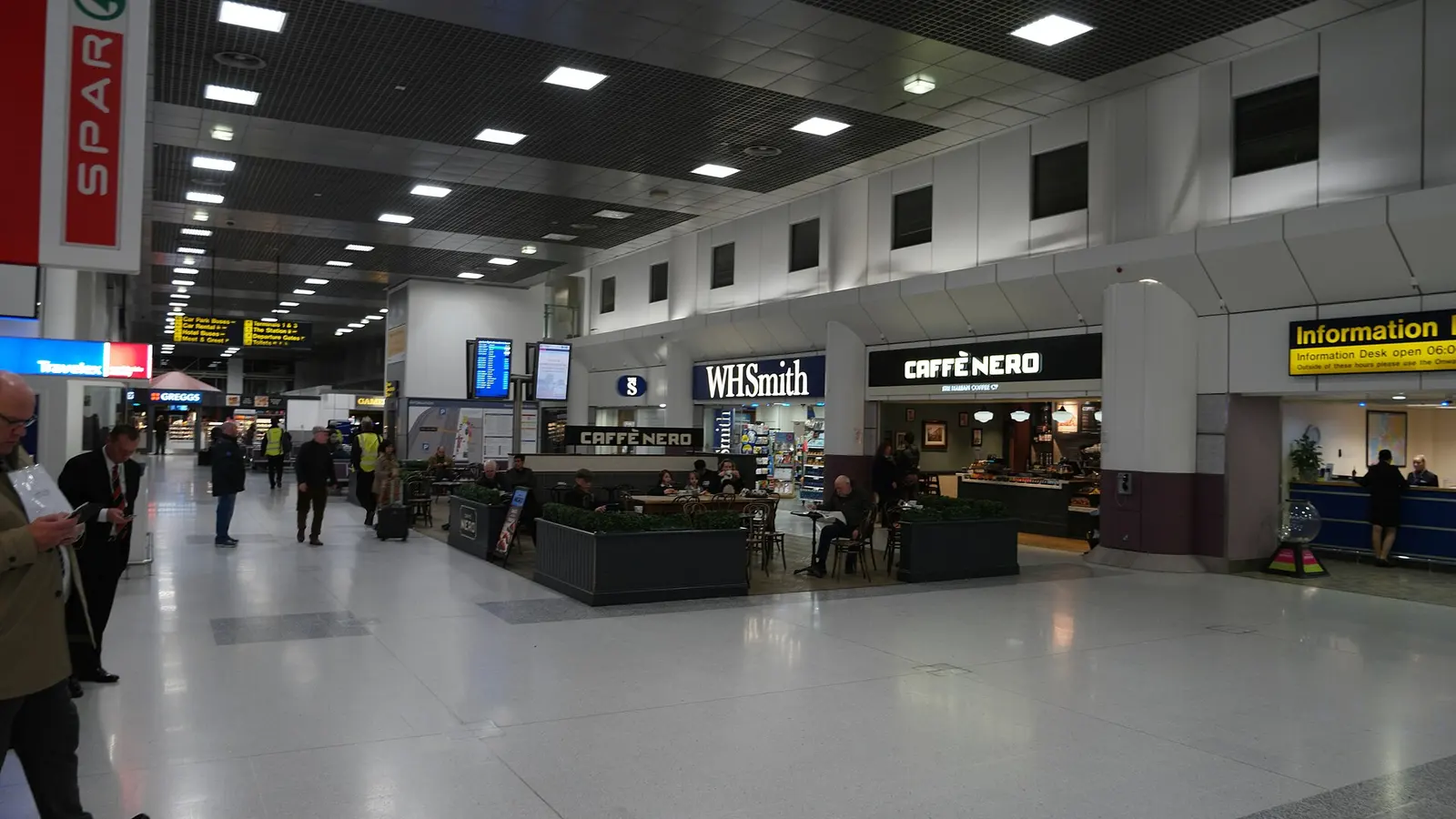
SIM card and money on the way. Still carrying your own currency? That is fine: every car takes cards and contactless, so you need no pounds in hand for the journey. If you want a UK SIM or some cash, say so and your driver will point you to the kiosks in arrivals (SIM cards: WHSmith in arrivals; currency: ICE desk in the terminal) or, usually cheaper, stop at a supermarket, Post Office or bank on the route to Manchester. Our local drivers know where the fair rates and the working cash machines are – trust them to sort it in minutes.
Disabled-friendly arrival.Special assistance: Tell your airline when booking or at least 48h before departure; the Assisted Travel team meets you; help points including lower level near Gates 20-28. Step-free: Lifts before the departure lounge; DART step-free. Guide & assistance dogs: Register your assistance dog via the airport page; relief area outside the terminal front near bus stop T; airside via Assisted Travel staff. Airport accessibility page Our driver meets you at the assistance desk if you prefer, carries folding wheelchairs and walkers free, and assistance dogs always travel with you at no charge.
Get an Instant Quote
🦉Tripadvisor Travelers' Choice 2025Excellent★★★★★★ Trusted24/7 UK Support
★★★★★ Five-star rated by passengers who landed in the wrong county and slept in the right one.
Luton Airport sits a minute from the M1, and Manchester sits at the other end of it — about 160 miles, covered in 2h45 to 3h30 by one pre-booked car. The railway’s counter-offer reads like a warning label: no direct service, a compulsory change, a best case of 3h02 and an average of 4h49 — per person, with luggage hauled between stations mid-journey. This desk runs the long version of what it does everywhere else: fare fixed in writing before travel, flight tracked to the minute, a boot sized to the party — and a rescue service for the two moments this route exists for: the diverted flight and the missed last train north.
The one British airport built practically on the M1 — which makes it the best place in the south to start a journey north.
The Long Spine, Read Properly
The road north: three legs, three kinds of knowledge
A 160-mile run is not a scaled-up local job — it is a different discipline. Fuel, driver hours, weather windows and two cities’ rush hours all sit inside the plan, and each third of the route asks a different question.
View from an aircraft window above the clouds
LEG / 01
The sixty-second start
Luton’s rare gift: the airport drive empties almost straight onto the M1. No urban crawl, no orbital, no warm-up act — wheels turning at the terminal become motorway miles inside a minute, which is why our quoted times start leaner here than at any London airport.
LEG / 02
The Catthorpe pivot
Mid-route, the M1 hands the journey to the M6 at the Catthorpe Interchange — the three-way knot where the A14’s freight joins the party. Its congestion has a daily rhythm our drivers read before departure, and the rare bad day has a rehearsed answer via the M45 and A5.
LEG / 03
The Manchester approach
Past Stoke the real choice arrives: M6 to the M56 for the airport, Trafford and the south, or the A556 cut for Didsbury and the centre — and matchday closures around the stadiums re-draw the map forty times a season. The last ten miles are where local knowledge earns its keep.
Long-run craft, stated plainly: every journey over two hours carries a planned comfort stop on request, drivers are rostered fresh for night legs rather than bolted onto a day’s work, and winter departures are checked against the Pennine weather picture before the car leaves base. None of this appears on a meter — all of it appears in the fact that you arrive well.
Diverted flights and missed last trains: the two emergencies we planned for
Nobody browses this page for fun. Most readers arrive mid-crisis: a Manchester-bound aircraft has just landed at Luton in fog, or a late arrival has watched the last sensible train north leave without them. Both have a fix, and it helps to know how the fix works before you need it.
The diversion play
The scene: weather or an airfield closure sends your Manchester flight to Luton, and the airline’s recovery coaches are “being arranged” — a phrase that famously measures itself in hours. Meanwhile the M1 is sitting right outside, pointing exactly where you were meant to be.
The move: call or WhatsApp the desk the moment the diversion is announced — even from the taxiway. Cars are positioned on demand, and diversion nights are exactly when minutes of head start matter, because every stranded flight-load has the same idea forty minutes later than you.
The multiplier: an MPV splits the fare across the strangers standing next to you at the carousel — four or six passengers who will all beat the recovery coach to Manchester by hours, for less per head than the story will cost them to tell.
The midnight play
The scene: Luton’s late wave lands from ten onward, and by the time bags appear the connections north have thinned to theory. The timetable’s small print means an airport bench until morning — or it would, if the road did not exist.
The move: pre-book against your flight number and the question never arises — the car is tracking you from origin, meets you inside arrivals whatever the delay, and the small-hours M1 runs the journey at its 2h45 best while the timetable sleeps.
The arithmetic: home in Didsbury or Salford by 3am beats a night purchased in instalments — the bench, the 6am connection, the onward leg, the lost morning. One written fare, one unbroken journey, your own bed at the end of it.
Honest small print on rescues: pre-booked jobs are guaranteed; same-moment diversion calls are answered with whatever cars genuinely exist that night — usually yes, occasionally a short wait, never a pretend promise. The desk will tell you the real pickup time before you commit, which on a diversion night is worth more than any slogan.
The Timetable, Given Its Fair Hearing
Car versus rail over 160 miles: the numbers do the arguing
Britain’s railways do London-to-Manchester brilliantly — from Euston. From Luton they do not, because Luton sits on the wrong main line for the north-west, and every itinerary must borrow a connection to fix that accident of geography.
What the timetable offers
No through train exists: around 99 itineraries a day, eight different operators holding pieces of the puzzle, and every single route demanding at least one change — often the cross-London shuffle between termini with everything you packed.
The averages, printed: 3h02 when the connection lands perfectly; 4h49 on average when it does not — longer than some of the flights that just landed you at Luton.
The fair concession: a lone traveller with a cabin bag, a flexible afternoon and a cheap advance ticket can do it for less money — and when that is the trip, we say take the train without a flicker of shame.
What one car changes
Time behaves: 2h45 to 3h30 door to door, no connection roulette, no termini, no platforms — the 4h49 lottery replaced by a band we plan inside.
The per-car rule: rail multiplies by heads; we do not. Two travellers halve the comparison, four demolish it — and a diverted flight-load sharing an MPV pays less per person than almost any same-day rail fare to Manchester.
Advance tickets die in a diversion: the cheap rail fare assumes the journey you planned, not the airport you actually landed at. A fixed car fare quoted from where you are is the only price that survives contact with a disrupted day.
Geo Guide · The Delivery End
The Manchester end: where 160 miles actually finishes
A long-distance run is judged by its final ten minutes. “Manchester” spans a city region of nearly three million people, and where in it you are going changes the road in, the timing and the craft — so the desk quotes to the postcode, never to the city.
Manchester area drop-off zones for Luton transfers
Drop-off zone
What it is
What the booking accounts for
City centre & Deansgate
The hotel core — towers, conference blocks and the nightlife grid
Approach chosen by hour: the A556 cut for evenings, the M602 line when the centre’s west side flows better — and hotel forecourts named in advance
Salford Quays & MediaCity
The waterfront studios and apartment blocks where broadcast Britain lives
Early-call crews and late finishes are the rhythm here — drops timed to shift patterns, security gates known by name
The two stadiums
Old Trafford west, the Etihad east — and forty-plus matchdays a season between them
Kick-off closures re-route the last mile entirely; we hold the fixture list and quote around it rather than discovering it at the barrier
The universities corridor
Oxford Road’s campus mile — one of Europe’s densest student quarters
September arrivals from Luton’s budget routes delivered hall-exact, luggage-heavy, with the bus-gate camera zones respected
Manchester Airport
The north’s intercontinental hub, M56 Junction 5
The repositioning classic: your cancelled Luton departure rebooked onto a Manchester flight — we deliver terminal-exact with check-in margin calculated backward
Stockport, Didsbury & the south
The leafy first arrivals off the M56/A34 approach
Often twenty minutes quicker than the centre — and quoted accordingly, because you should not pay city-centre time for a suburb that arrives early
Trafford & Altrincham
The south-western boroughs around the Bridgewater Canal
M56 exit craft and school-run windows factored into afternoon arrivals
Bury, Bolton, Rochdale & the north
The ring of towns past the city on the M60’s orbit
The orbital’s own rush hours priced in — and the quote built from your exact town, not a city-centre average plus hope
↔ Swipe the table sideways on mobile
Both directions, same discipline: the Manchester-to-Luton leg serves the flights Luton uniquely flies — the budget network’s dawn departures south — and runs on the identical fixed-fare, tracked basis. Book the round trip together for one reference and the return discount, or pair this run with our Manchester Airport transfers when the itinerary flies out of the north instead.
The Standing Diary
Four Luton–Manchester runs the desk recognises by the first sentence
RUN / A
The fog-night four
A Manchester flight parked on a Luton stand at 21:40, four strangers united by one carousel and one idea. MPV loaded by 22:20, fare split four ways, M62 signs by half past midnight — while the recovery coach was still “being arranged”.
RUN / B
The 00:40 budget landing
Late Wizz arrival, bags at one, every train north long gone. Pre-booked against the flight number, met at the doors, asleep by Toddington services — a Didsbury front door at 3am instead of an airport bench until six.
RUN / C
The repositioned flyer
Luton departure cancelled, airline rebooks tomorrow’s seat — from Manchester. One car turns a ruined itinerary into a night’s sleep up north and a terminal-exact drop with margin to spare. The airline broke the plan; the M1 repaired it.
RUN / D
The matchday party
Six friends, one European away leg home into Luton, one Old Trafford fixture the next evening. Group vehicle north, fixture-aware drop streets clear of the closure ring, and the only queue of the weekend was for pies.
Manchester Airport · Photo: Bob Harvey, CC BY-SA 2.0 via Wikimedia Commons
Luton to Manchester taxi — the thirteen questions this route gets asked
How long does a taxi from Luton to Manchester take?
2h45 to 3h30 for roughly 160 miles — the M1 from the airport’s doorstep, the M6 from the Catthorpe Interchange, and the M56 or A556 approach chosen by your exact destination. Night runs sit at the quick end because both cities’ rush hours are asleep; weekday afternoons earn the caution. Every booking names a pickup or arrival window built from the hour you actually travel, not a single flattering number.
How much does a Luton to Manchester taxi cost?
A fixed figure in writing before travel — vehicle sized to the party, meet-and-greet, waiting time and all road costs inside it, no meter ticking through 160 miles, no night supplement. The comparison that matters: rail sells this journey per person with a compulsory change, so from two travellers the car narrows the gap and from four it wins outright — before anyone mentions the luggage. Send party size, date and flight number to the WhatsApp desk and the exact quote lands within minutes, with a discount when both directions book together.
Is there a direct train from Luton to Manchester?
No — and the detail deserves daylight. Around 99 itineraries run daily, spread across eight operators, and every one requires at least a change; the fastest manages 3h02 when the connection is perfect, and the day’s average is 4h49. Luton simply sits on the wrong main line for the north-west. For a solo traveller with an advance ticket and no deadline, the train can still be the budget play — for everyone else, the road is shorter, simpler and shared.
My Manchester flight just got diverted to Luton — can you actually help right now?
That is this page’s founding scenario. Call or WhatsApp the moment the diversion is announced — from the aircraft if you can — because cars are positioned on demand and diversion nights reward the earliest callers. We answer with a genuine pickup time, not a promise; usually it beats the airline’s recovery coach by hours. Standing next to strangers with the same problem? An MPV splits one fixed fare across the group, and everybody wins the night.
I land at Luton after midnight — is Manchester still reachable?
Comfortably — it is one of our standing runs. Pre-book against the flight number and the car tracks you from origin, meets you inside arrivals whatever the delay, and runs the small-hours M1 at its emptiest — the 2h45 version of the journey. You are home in Greater Manchester in the middle of the night instead of opening a departure lounge at dawn, and the fare is the same written figure it was at booking, whatever the clock says.
Can you drop anywhere in Greater Manchester, or just the centre?
Anywhere — and the quote is built from the exact postcode because the region is genuinely large. Stockport and Didsbury arrive off the M56 before the centre does; Bury, Bolton and Rochdale add the M60’s orbit; Salford Quays, MediaCity, the universities corridor and both stadiums each carry their own approach craft. City-centre pricing for a suburb that arrives twenty minutes early would be lazy — we quote the journey you are actually taking.
My airline rebooked my cancelled Luton flight to depart from Manchester — can you get me there?
This is the repositioning run, and it is more common than most travellers imagine. Give the desk the new flight’s departure time and we build the journey backward from its check-in deadline — terminal-exact drop at Manchester Airport with honest margin, an overnight option in the city if the rebooking is for morning, and the whole plan in one written fare. The airline moved the goalposts; the M1 and M6 move you.
Do you handle matchday runs to Old Trafford or the Etihad?
Season-round — and the craft is real. Both stadiums close their surrounding streets around kick-off and full-time, re-drawing the final mile forty-plus times a season, so we hold the fixture calendar and route the drop to the correct side of the closure ring before it forms. Group vehicles carry travelling supports up from Luton’s European arrivals, one booking, one fare split, everyone inside before the teams are.
What happens on a long run if my flight is delayed?
The booking re-times itself — we track the aircraft from its origin airport, so the driver’s 160-mile plan shifts while you are still airborne, and included waiting absorbs the arrivals hall’s pace. A delay never becomes a surcharge, and on a journey this length that matters twice: the car that meets you is fresh for the road, not one that has idled three hours into its driving window.
Is a 160-mile taxi journey actually comfortable?
Engineered to be. Long-run vehicles are selected for motorway manners and boot space, a comfort stop is planned on request rather than begrudged, night legs are rostered to fresh drivers, and winter departures are checked against the weather picture over the high ground before setting off. Passengers sleep, work or watch the country change out of the window — the journey is the rest, not the ordeal between rests.
Do you run Manchester to Luton as well?
Daily — the southbound leg serves the flights only Luton flies: the budget network’s dawn wave to destinations Manchester never lists. Departure runs are built backward from check-in with the M6’s morning moods priced in, overnight positioning is available for the earliest take-offs, and the round trip booked together holds one reference and earns the return discount. Same corridor, same discipline, opposite clock.
Why pre-book instead of finding a car when I land?
Because 160 miles is not an impulse purchase — for you or for a driver. Pre-booking through a licensed operator guarantees the hire-and-reward insurance that covers paying passengers, a vetted driver planned onto the route fresh, a vehicle sized to your luggage before wheels-down, and a fare that cannot inflate with the night. It also buys the tracker that saw your delay and the desk that answers at 2am — none of which waits at a rank on a diversion night, when the rank is forty people deep.
Can students use this route for September arrivals?
Every autumn — Luton’s budget network is how much of Europe reaches Manchester’s universities cheaply, and the last leg with a year’s luggage is exactly what a fixed-fare car exists for. Hall-exact delivery along the Oxford Road corridor and beyond, coursemates off the same flight splitting one fare, and parents booking from abroad holding the whole arrangement in writing before their child boards. The flight saved the money; the car saves the arrival.
Making the Most of Your Journey: Stops & Sightseeing
Eat & shop like a Londoner: fish & chips, roast, afternoon tea, pies, ale, vegan, British brands – with prices (tap to open)
Eat and shop like a Londoner: fish & chips, Sunday roast, full English, afternoon tea, pies, pale ale, vegan & the best British brands
Our drivers get asked for these every day, so here is the shortlist we give in the car. Prices are from the venues’ own menus and booking sites (seen October 2026); tap the Google Maps link for photos, today’s menu and star ratings. Want a stop on the way? Say so when you book and the driver will wait.
Fish & chips
Poppies Fish & Chips Spitalfields E1, Soho W1, Camden NW1, Portobello W11 1950s East End chippy, haddock and cod fried to order, mushy peas cod & chips £21.99, haddock £20.99 (menu) website · photos, menu & ratings on Google Maps
Golden Union Poland St, Soho W1 Proper chippy with a sit-down room, gluten-free batter on request about £15–£19 for fish and chips website · photos, menu & ratings on Google Maps
Sunday roast
Hawksmoor Seven Dials WC2, Borough SE1, Air Street W1, Wood Wharf E14, Knightsbridge The roast most Londoners name first: dry-aged rump, beef-dripping roast potatoes, Yorkshire pudding Sunday roast rump £29.50 (menu); book ahead website · photos, menu & ratings on Google Maps
Blacklock Soho W1, Shoreditch EC2, Covent Garden WC2, Canary Wharf E14 Chop-house roasts with all the trimmings and bottomless gravy roast about £24–£28 (menu) website · photos, menu & ratings on Google Maps
English breakfast
E Pellicci 332 Bethnal Green Rd E2 Family caff since 1900, Art Deco interior, fry-ups and Italian specials; cash-friendly, Mon–Sat mornings full English about £10–£13 website · photos, menu & ratings on Google Maps
The Wolseley 160 Piccadilly W1 Grand café breakfast under chandeliers: the full English, kedgeree, eggs Benedict full English about £20–£24 (menu) website · photos, menu & ratings on Google Maps
Afternoon tea
The Ritz, Palm Court 150 Piccadilly W1 The classic: finger sandwiches, scones, pastries and a pianist; jacket and tie for men, book weeks ahead £85 a head, £105 with Champagne (2026); 12.5% service added website · photos, menu & ratings on Google Maps
Fortnum & Mason, Diamond Jubilee Tea Salon 181 Piccadilly W1 Fortnum’s own teas, a trolley of cakes and the famous scones from £75 a head (2026) website · photos, menu & ratings on Google Maps
Pies
Mother Mash Carnaby St, Soho W1 Pie, mash and gravy or sausage and mash, choose your mash and your gravy pie, mash & gravy from about £15 website · photos, menu & ratings on Google Maps
Pieminister Leather Lane EC1 and across London Award-winning British pies incl. vegan and veggie; takeaway or sit in pie & mash about £12–£15 website · photos, menu & ratings on Google Maps
British pale ale
The Churchill Arms Kensington Church St W8 Flower-covered Fuller’s pub, London Pride on cask, Thai kitchen at the back pint about £6–£7 website · photos, menu & ratings on Google Maps
Ye Olde Cheshire Cheese Fleet St EC4 Rebuilt 1667, Dickens drank here; Samuel Smith’s ales, cellar bars pint about £5–£6 (no cards in some Sam Smith’s pubs – carry cash) website · photos, menu & ratings on Google Maps
Vegan & vegetarian
Mildreds Lexington St, Soho W1 (also Camden, King’s Cross, Dalston, Covent Garden) London’s best-known vegetarian restaurant since 1988, now fully plant-based about £38 a head (TheFork); mains £15–£20 rated 9.3/10 on TheFork, 2,800+ Tripadvisor reviews website · photos, menu & ratings on Google Maps
Fortnum & Mason 181 Piccadilly W1 Tea, biscuits, marmalade and hampers in the famous eau-de-nil tins since 1707 tea caddies from about £10; hampers £50+ website · photos, menu & ratings on Google Maps
Liberty London Regent St W1 Tudor-fronted store for Liberty print scarves, Barbour, Burberry, Mulberry and British designers scarves from about £45 website · photos, menu & ratings on Google Maps
Tipping: 10–12.5% service is often added in restaurants, never in pubs or chippies. Most places take cards; a few old caffs and Sam Smith’s pubs are cash-only. Vegan and gluten-free options are marked on almost every London menu – just ask. The airport shops sell the same tea tins and biscuits at 2–3 times the supermarket price, so buy souvenirs in town.
Landed in the wrong county? That is a fare, not a crisis.
One hundred and sixty miles, one written figure, one unbroken journey — diversions rescued, midnight landings met, matchdays mastered, and the north reached while the timetable is still explaining itself.