Get London Transfer Ltd is a TfL licensed private hire operator - London private hire operator licence number 11588. getlondontransfer.co.uk and rushxo.com are trading names of Get London Transfer Ltd, and rushxo.co.uk is the UK site of rushxo.com. Every booking made on these websites is operated by Get London Transfer Ltd.
Stansted → Luton Taxi · 40 Miles · Budget-to-Budget · From £106 Fixed
Your Stansted to Luton taxi, the missing link between Britain's two budget fortresses.
Landing at Stansted Airport? Let us take the stress off
Your driver is waiting with a name board the moment you come through customs into arrivals – not in a car park, not on the phone. We track the flight, so a late landing costs you nothing, and the first 60 minutes after the plane lands are free waiting time. Luggage trolleys, a child seat, a wheelchair-friendly car: tell us when you book and it is ready.
SIM card and money on the way. Still carrying your own currency? That is fine: every car takes cards and contactless, so you need no pounds in hand for the journey. If you want a UK SIM or some cash, say so and your driver will point you to the kiosks in arrivals (SIM cards: WHSmith in arrivals; currency: ICE / Travelex desks in the arrivals concourse) or, usually cheaper, stop at a supermarket, Post Office or bank on the route. Our local drivers know where the fair rates and the working cash machines are – trust them to sort it in minutes.
Disabled-friendly arrival.Special assistance: Pre-book via airline/agent at least 48h ahead; Assisted Travel run by ABM; Assistance Desk Zone A before security. Step-free: Single-level terminal; lifts to the rail station. Guide & assistance dogs: Recognised assistance dogs welcome; relief areas at the far end of the forecourt (landside) and airside via the Assisted Travel team. Pets: Only assistance dogs and dogs travelling as passengers' pets enter the terminal. Airport accessibility page Our driver meets you at the assistance desk if you prefer, carries folding wheelchairs and walkers free, and assistance dogs always travel with you at no charge.
Get an Instant Quote
🦉Tripadvisor Travelers' Choice 2025Excellent★★★★★★ Trusted24/7 UK Support
Here's the joke geography plays on budget travellers: the Ryanair capital and the easyJet-and-Wizz capital sit forty miles apart with no railway between them. The train "option" needs four separate vehicles — express, tube, Thameslink, then the DART shuttle with its own extra fare — and the coach runs sparse, caps your luggage at one case, and answers to its own clock rather than your flights. Meanwhile your two tickets are separate bookings with zero airline protection if the connection collapses. This taxi run is the professional answer: one car, fixed from £115 with every vehicle priced below, both flights tracked, terminal door to terminal door on whichever of the two roads the hour favours. The self-connect, de-risked.
Two budget hubs, zero rail link, one fixed-price taxi bridge — driven with both your boarding passes in mind.
The Price · One Number, Everything In
Every vehicle, every price — the whole journey settled before you fly
Budget travel punishes surprises, so this fare doesn't contain any: terminal to terminal, luggage included, every charge inside, locked when you book.
Stansted Airport terminal · Photo: Black8Knight, CC BY-SA 4.0 via Wikimedia Commons
SaloonUp to 4 passengers · luggage included
£115
ExecutiveUp to 3 passengers · luggage included
£131
MPVUp to 6 passengers · luggage included
£130
V ClassUp to 7 passengers · luggage included
£171
9 SeaterUp to 8 passengers · luggage included
£175
Prices are fixed & include all charges; weekend peak (+10%) or the late-night London discount (−£11.55) auto-apply once you set your time. Secure the booking with just a 30% deposit and pay the balance on the day of travel. Four sharing the saloon pay £26.50 each — against four coach fares plus the one-case luggage rule, the direct tracked taxi removes every variable for pennies more. And the six-seat MPV at £130 is the group bargain of the corridor. Lock the fare →
The Self-Connect Reality · Two Tickets, No Net
Separate bookings, zero protection — the maths of not missing it
Nearly everyone on this corridor is stitching two cheap flights into one journey the airlines never promised. That's smart travel — provided the middle forty miles is treated as the risk it is.
The stage
What it consumes
The budget-terminal detail
Landing to kerbside at Stansted
25–50 min
Ryanair's waves land in clumps — passport and baggage queues swing wildly with the schedule's rhythm
The forty-mile bridge
55–75 min by car
The coach's scheduled 75–105 minutes assumes you matched its sparse timetable in the first place
Luton's own doorstep
Bag-drop 2 hrs+ before departure
easyJet and Wizz queues build early; the DART-and-Parkway crowd arrives in pulses that lengthen them
The gap you should book
5 hrs by coach · ~4 hrs by tracked car
With no airline protection, the buffer IS your insurance — the car's saved hour and managed delays are what shrink it safely
The honest sentence: a missed self-connect on separate budget tickets means buying a brand-new flight at today's price — the fixed-price bridge exists to make that outcome structurally unlikely. We track the inbound from its origin, the car re-times itself to your real landing, and the road hour is the corridor's shortest. Send both flight numbers to the desk and we'll tell you plainly whether your gap is comfortable, tight, or worth re-booking.
The Two Roads · Neither Is "The" Road
Cross-country line or motorway loop — chosen per run, not per habit
No motorway joins these airports directly, which leaves two honest candidates that behave nothing alike. Knowing which to trust at which hour is the local craft this corridor demands.
The cross-country line
The motorway loop
The shape
A120 out past Standon, the A602 through Stevenage, the A505 through Hitchin to Luton's door — about forty miles straight across Hertfordshire
M11 south, a swing of the M25's northern arc, then the M1 north to Luton's junction — fifty-five miles of full-speed tarmac
Where it shines
Shorter, immune to motorway pile-ups, and quietly consistent — the dependable spine of this run at most hours
Late evenings and small hours, when empty motorways turn the longer distance into the faster clock
Where it suffers
Town-edge roundabouts and school-hour Hitchin — it flows, but it never sprints
Three motorways means three exposures: one incident on the M25's arc and the loop becomes the trap
Our call
The daytime default, driven by people who know its rhythm
The night card and the escape route, played when the feeds say so
Why it matters to you: a coach is welded to its published routing and a sat-nav rethinks too late — but a driver holding both options, with your bag-drop deadline in mind, converts forty ambiguous miles into a decision made fresh at your kerb and revisited at every junction that allows a switch. That judgement, not the engine, is most of what the fixed fare buys.
The Alternatives, Priced Honestly
The four-vehicle train and the one-case coach — the full fine print
Both alternatives are real and both are cheaper solo. Here's exactly what each involves, so the choice is informed rather than discovered mid-journey.
Rail: the four-vehicle relay
The chain: Stansted Express to Tottenham Hale, Victoria line to King's Cross St Pancras, Thameslink to Luton Airport Parkway — then the DART shuttle, on its own separate fare, for the final hop to the terminal.
The cost of it: roughly two hours, three changes, escalators and concourses with every bag, and a combined ticket price that erodes the "cheap" rationale fast.
The verdict: defensible for one light traveller with hours to burn; miserable arithmetic for anyone else.
Coach: honest, sparse, capped
The credit: direct terminal to terminal from around £18 — solo and unhurried, it's fair value and we'll say so plainly.
The catches: a handful of departures a day (some gaps of two hours), a scheduled 75 to 105 minutes, a one-large-case luggage policy, and a timetable that neither knows nor cares that your inbound ran late.
The verdict: workable when your flights happen to bracket its clock generously; brittle the moment they don't.
Where the car takes over: two or more travellers, more than one case each, a gap under five hours, an inbound with any history of lateness, or simple unwillingness to gamble a non-refundable onward ticket on a relay — any single one of those flips the answer to the fixed-price taxi, and most self-connectors tick three.
Real Problems · Real Fixes
Six ways the budget bridge collapses — and the engineering against each
This corridor's failures are predictable enough to design out. Here's the standing list, and what's already in place before your first flight boards.
RISK / 01
The inbound that lands in a clump
The problem: Ryanair's wave scheduling means your on-time landing can still queue forty minutes for passports — margin gone before the kerb. Our fix: the tracking watches the aircraft, the driver's brief covers the wave, and the waiting is free while we can see the hall is jammed.
RISK / 02
The coach gap that swallows an hour
The problem: arrive kerbside eight minutes after a sparse departure and the next service may be two hours out — a hole no budget itinerary survives. Our fix: nothing to miss: the car's schedule is generated by your landing, not published in advance for you to chase.
RISK / 03
The second case the coach refuses
The problem: the one-large-suitcase policy meets a traveller relocating between budget flights with two — an argument at a coach door you cannot win. Our fix: declare the bags at booking; the boot swallows them, and if they outgrow a saloon we quote the bigger vehicle before the day, not at the kerb.
RISK / 04
The DART discovery
The problem: rail travellers reaching Luton Airport Parkway and learning the terminal is still a separate shuttle — with a separate fare — away, cases in hand, connection ticking. Our fix: our journey ends at the terminal building itself; the word "Parkway" never enters it.
RISK / 05
The loop trap on a bad afternoon
The problem: a screen-guided driver commits to the three-motorway loop as the M25's arc seizes — the "fast" road becoming the slowest room in Hertfordshire. Our fix: both roads held live to the last junction; the cross-country line is the standing insurance no incident cancels.
RISK / 06
The 4am connector nobody serves
The problem: budget schedules love brutal hours, and the corridor's public options thin to nothing exactly when the first Wizz departures need feeding. Our fix: the desk runs all night; the small-hours crossing is dispatched with slack, at the same fixed price the afternoon pays.
Who Crosses This Bridge
The four traveller stories this corridor runs on
RUN / A
The self-connect strategists
The core traffic: a cheap Ryanair leg in, a cheap easyJet or Wizz leg out, stitched by choice into one journey. Both flights tracked, the gap assessed honestly before booking, and the bridge driven so the strategy survives contact with reality.
RUN / B
The repositioned & the rebooked
Cancellations and schedule changes that strand a traveller at one budget hub with a replacement flight from the other — the crossing nobody planned, needed fast, at whatever hour the disruption chose. The 24/7 desk is built for exactly this call.
RUN / C
The groups doing the maths
Families and friend-groups who ran the numbers: four coach fares plus the luggage cap plus the timetable risk against £27.50 a head in a tracked car — and booked the taxi — the version where everyone travels together with all the bags.
RUN / D
The crews & the regulars
Airline staff repositioning between bases, freight and ops people on split shifts, and the corridor's quiet weekly commuters — travellers who value the fixed price precisely because they make this crossing often enough to know its traps.
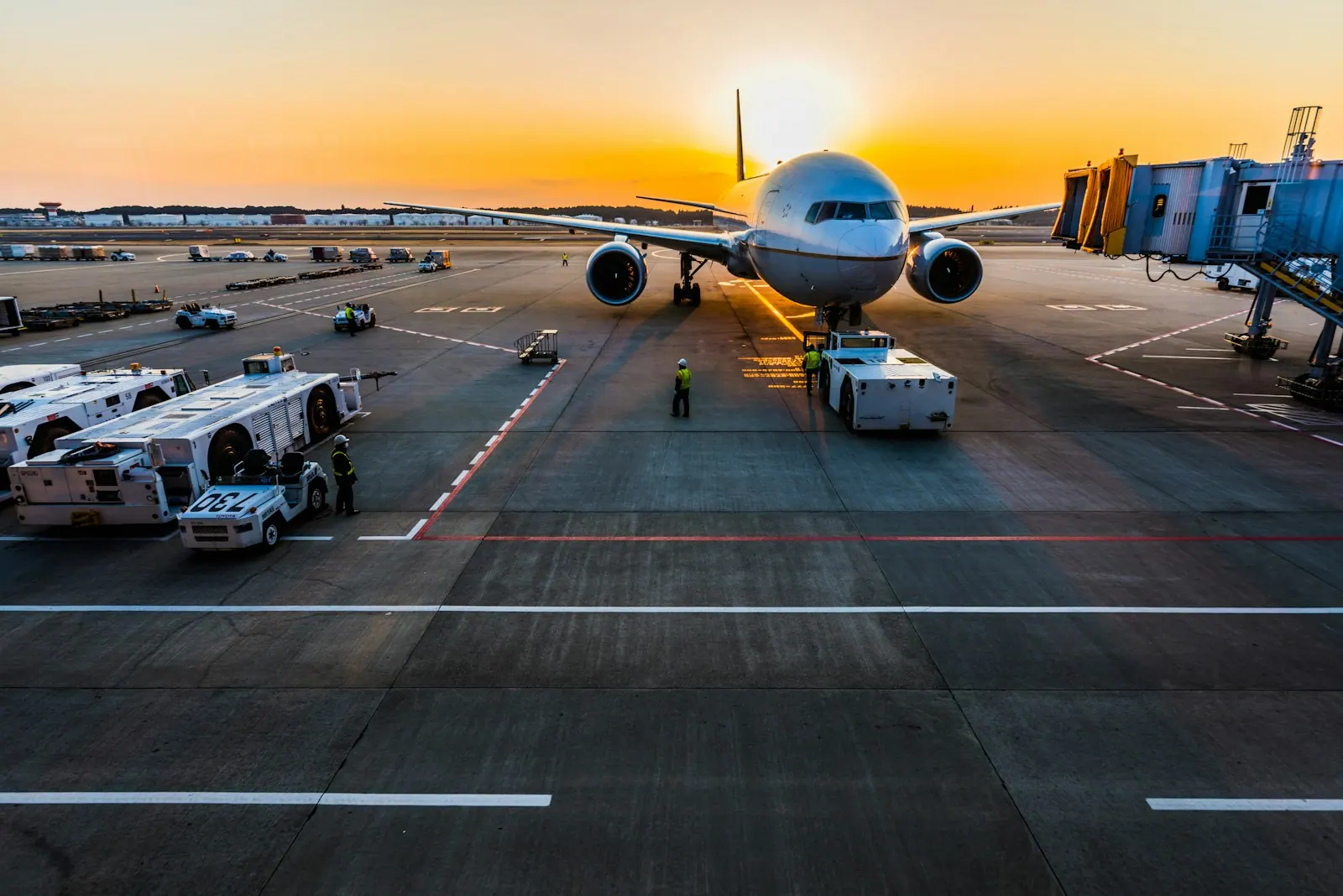
Aircraft at the airport gate at sunset
Your Rights · The Structure Behind the Fixed Price
What licensed and pre-booked locks in on an airport-to-airport run
A fixed price is a promise; licensing is the enforcement. Here's what the framework guarantees between two terminals where you know nobody.
The guarantees in law
A booking before a wheel turns: private hire regulation ties every lawful journey to a licensed operator's logged booking — your crossing exists on our system, driver assigned, while you're still abroad.
Three-layer vetting: company licence, driver checks, vehicle inspection — each verified upstream so nothing about the car at the kerb is your gamble.
Insurance in force: the passenger cover of a lawful booking spans the full forty miles — protection an informal airport offer simply doesn't carry.
The guarantees you feel
£106 means £106: the number survives the hour, the road chosen, the delay absorbed and the demand around it — settled before travel, untouchable after.
A desk that knows both flights: 24/7, watching your inbound and aware of your onward — a call answered by someone already holding both boarding passes’ context.
A name that answers tomorrow: a licensed firm attached to the job — the accountability that separates a licensed taxi service from a stranger with a car.
The compressed version: vetted, insured, tracked and price-locked — the licence turns a forty-mile leap of faith between two unfamiliar terminals into a managed, answerable service. That's the machinery under the fixed fare.
Straight Answers
Stansted to Luton taxi — the questions, answered properly
How much is a Stansted to Luton taxi?
The full menu is published and fixed: £115 for the saloon (up to four passengers), £131 executive (up to three), £130 for the six-seat MPV, £171 for the V Class (up to seven) and £160 for the 9-seater (up to eight) — luggage and every charge inside, terminal building to terminal building, secured with a 30% deposit and settled on the day. Nothing meters, nothing surges, and the small-hours crossing costs what the lunchtime one does. Shared four ways the saloon is £26.50 a head — against four coach fares, the one-case luggage policy and the timetable gamble, the quiet bargain of the corridor.
How long does the Stansted to Luton taxi take?
The taxi covers the forty-odd miles in typically 55 to 75 minutes. Two genuine routes exist — the cross-country line through Standon, Stevenage and Hitchin, and the three-motorway loop via the M11, M25 and M1 — and they excel at opposite hours, so the driver commits at your kerb from live conditions and keeps the alternative in reserve. Night crossings regularly beat the hour; peak afternoons are why the buffer advice below exists.
How big a gap should I leave between my two flights?
On separate budget tickets, the buffer is your only insurance — no airline owes you a rebooking if the chain breaks. Coach-based guides suggest five hours minimum, and they're right for a sparse timetable you might miss. The tracked taxi changes the maths: the road hour is the corridor's shortest, the pickup re-times to your real landing, and delays are managed rather than discovered — so a four-hour gap typically works in comfort. Send both flight numbers and we'll give you a straight verdict on yours, including when the honest answer is "rebook the second leg".
Why is the train so awkward between these two airports?
Because no line was ever built between them — the rail journey is a relay through London: Stansted Express to Tottenham Hale, the Victoria line across to King's Cross St Pancras, Thameslink out to Luton Airport Parkway, and then the DART shuttle — a separate vehicle with a separate fare — to finally reach the terminal. Four vehicles, three changes, roughly two hours, and every escalator with your cases. It exists; for a timed self-connect it's the option most likely to break, which is why almost nobody serious uses it.
What happens if my first flight is delayed?
The system absorbs it — that's its whole design. Your inbound is followed from its departure airport, so a slip shows on our side while you're still at the gate; the car's schedule shifts with the aircraft rather than the booking form; the waiting stays free through the passport and baggage queues we can see you're stuck in; and because your onward flight number sits on the same job sheet, the desk can tell you in real time whether the connection still breathes or needs action. A coach departs regardless and a train relay compounds every slip — the tracked taxi is the only mode on this corridor that responds.
Do you run Luton to Stansted as well, and the other airport pairs?
Every day, same fixed-price taxi in reverse, same dual tracking. And the wider network is covered too — our Heathrow to Gatwick and Gatwick to Heathrow guides run the same terminal-to-terminal service with published prices from £123, and the Stansted and Luton airport pages cover every other destination. One desk, every pair: WhatsApp, phone or email.
Making the Most of Your Journey: Stops & Sightseeing
Eat & shop like a Londoner: fish & chips, roast, afternoon tea, pies, ale, vegan, British brands – with prices (tap to open)
Eat and shop like a Londoner: fish & chips, Sunday roast, full English, afternoon tea, pies, pale ale, vegan & the best British brands
Our drivers get asked for these every day, so here is the shortlist we give in the car. Prices are from the venues’ own menus and booking sites (seen October 2026); tap the Google Maps link for photos, today’s menu and star ratings. Want a stop on the way? Say so when you book and the driver will wait.
Fish & chips
Poppies Fish & Chips Spitalfields E1, Soho W1, Camden NW1, Portobello W11 1950s East End chippy, haddock and cod fried to order, mushy peas cod & chips £21.99, haddock £20.99 (menu) website · photos, menu & ratings on Google Maps
Golden Union Poland St, Soho W1 Proper chippy with a sit-down room, gluten-free batter on request about £15–£19 for fish and chips website · photos, menu & ratings on Google Maps
Sunday roast
Hawksmoor Seven Dials WC2, Borough SE1, Air Street W1, Wood Wharf E14, Knightsbridge The roast most Londoners name first: dry-aged rump, beef-dripping roast potatoes, Yorkshire pudding Sunday roast rump £29.50 (menu); book ahead website · photos, menu & ratings on Google Maps
Blacklock Soho W1, Shoreditch EC2, Covent Garden WC2, Canary Wharf E14 Chop-house roasts with all the trimmings and bottomless gravy roast about £24–£28 (menu) website · photos, menu & ratings on Google Maps
English breakfast
E Pellicci 332 Bethnal Green Rd E2 Family caff since 1900, Art Deco interior, fry-ups and Italian specials; cash-friendly, Mon–Sat mornings full English about £10–£13 website · photos, menu & ratings on Google Maps
The Wolseley 160 Piccadilly W1 Grand café breakfast under chandeliers: the full English, kedgeree, eggs Benedict full English about £20–£24 (menu) website · photos, menu & ratings on Google Maps
Afternoon tea
The Ritz, Palm Court 150 Piccadilly W1 The classic: finger sandwiches, scones, pastries and a pianist; jacket and tie for men, book weeks ahead £85 a head, £105 with Champagne (2026); 12.5% service added website · photos, menu & ratings on Google Maps
Fortnum & Mason, Diamond Jubilee Tea Salon 181 Piccadilly W1 Fortnum’s own teas, a trolley of cakes and the famous scones from £75 a head (2026) website · photos, menu & ratings on Google Maps
Pies
Mother Mash Carnaby St, Soho W1 Pie, mash and gravy or sausage and mash, choose your mash and your gravy pie, mash & gravy from about £15 website · photos, menu & ratings on Google Maps
Pieminister Leather Lane EC1 and across London Award-winning British pies incl. vegan and veggie; takeaway or sit in pie & mash about £12–£15 website · photos, menu & ratings on Google Maps
British pale ale
The Churchill Arms Kensington Church St W8 Flower-covered Fuller’s pub, London Pride on cask, Thai kitchen at the back pint about £6–£7 website · photos, menu & ratings on Google Maps
Ye Olde Cheshire Cheese Fleet St EC4 Rebuilt 1667, Dickens drank here; Samuel Smith’s ales, cellar bars pint about £5–£6 (no cards in some Sam Smith’s pubs – carry cash) website · photos, menu & ratings on Google Maps
Vegan & vegetarian
Mildreds Lexington St, Soho W1 (also Camden, King’s Cross, Dalston, Covent Garden) London’s best-known vegetarian restaurant since 1988, now fully plant-based about £38 a head (TheFork); mains £15–£20 rated 9.3/10 on TheFork, 2,800+ Tripadvisor reviews website · photos, menu & ratings on Google Maps
Fortnum & Mason 181 Piccadilly W1 Tea, biscuits, marmalade and hampers in the famous eau-de-nil tins since 1707 tea caddies from about £10; hampers £50+ website · photos, menu & ratings on Google Maps
Liberty London Regent St W1 Tudor-fronted store for Liberty print scarves, Barbour, Burberry, Mulberry and British designers scarves from about £45 website · photos, menu & ratings on Google Maps
Tipping: 10–12.5% service is often added in restaurants, never in pubs or chippies. Most places take cards; a few old caffs and Sam Smith’s pubs are cash-only. Vegan and gluten-free options are marked on almost every London menu – just ask. The airport shops sell the same tea tins and biscuits at 2–3 times the supermarket price, so buy souvenirs in town.
No four-vehicle relay, no one-case coach clock, no gamble on an unprotected connection — both flights tracked, both roads held, and prices that were final before you flew. Stansted to Luton, done the way the stakes deserve.