Get London Transfer Ltd is a TfL licensed private hire operator - London private hire operator licence number 11588. getlondontransfer.co.uk and rushxo.com are trading names of Get London Transfer Ltd, and rushxo.co.uk is the UK site of rushxo.com. Every booking made on these websites is operated by Get London Transfer Ltd.
Canary Wharf → Heathrow · 22 Miles · London at Its Widest · Fixed Fare
Canary Wharf to Heathrow taxi — for flights that leave before the trains wake
Canary Wharf to Heathrow is 21 to 23 miles across London: 50 to 80 minutes by taxi in daytime traffic and 35 to 45 minutes late at night or before dawn. The Elizabeth line runs direct to Terminals 2, 3 and 4 in about 45 to 52 minutes, but weekday trains start around 5:30am and Terminal 5 needs a change, which is when a fixed-fare car wins.
Get an Instant Quote
🦉Tripadvisor Travelers' Choice 2025Excellent★★★★★★ Trusted24/7 UK Support
Here is the timing truth that defines E14: the towers' travel diary runs on dawn long-hauls and red-eye returns, and the bulk of this corridor's journeys happen before six in the morning or after nine at night — while the celebrated Elizabeth line opens for business around half past five on a weekday and later still on a Sunday. A 7am Frankfurt or an 8am JFK wants you moving by five, luggage loaded, calls already possible. That is a car's hour, and this is that car: a fixed-fare transfer from your tower lobby or apartment door — congestion charge, emissions and forecourt fees already inside the number — driven across the full width of London by people who read the Limehouse Link, the Embankment and the elevated M4 like a trading screen. Booked with a 30% deposit, tracked on the way home, and dispatched at whatever hour the flight demands, because in this postcode that hour is rarely a sociable one.
Twenty-two miles, the whole capital in between, and a clock that starts before the city does.
The 5am Problem · This Corridor's Defining Fact
E14's flights against E14's timetable — the mismatch in numbers
Most transfer pages compare journey times. On this corridor the real comparison is availability at the hour you actually travel — and that comparison isn't close.
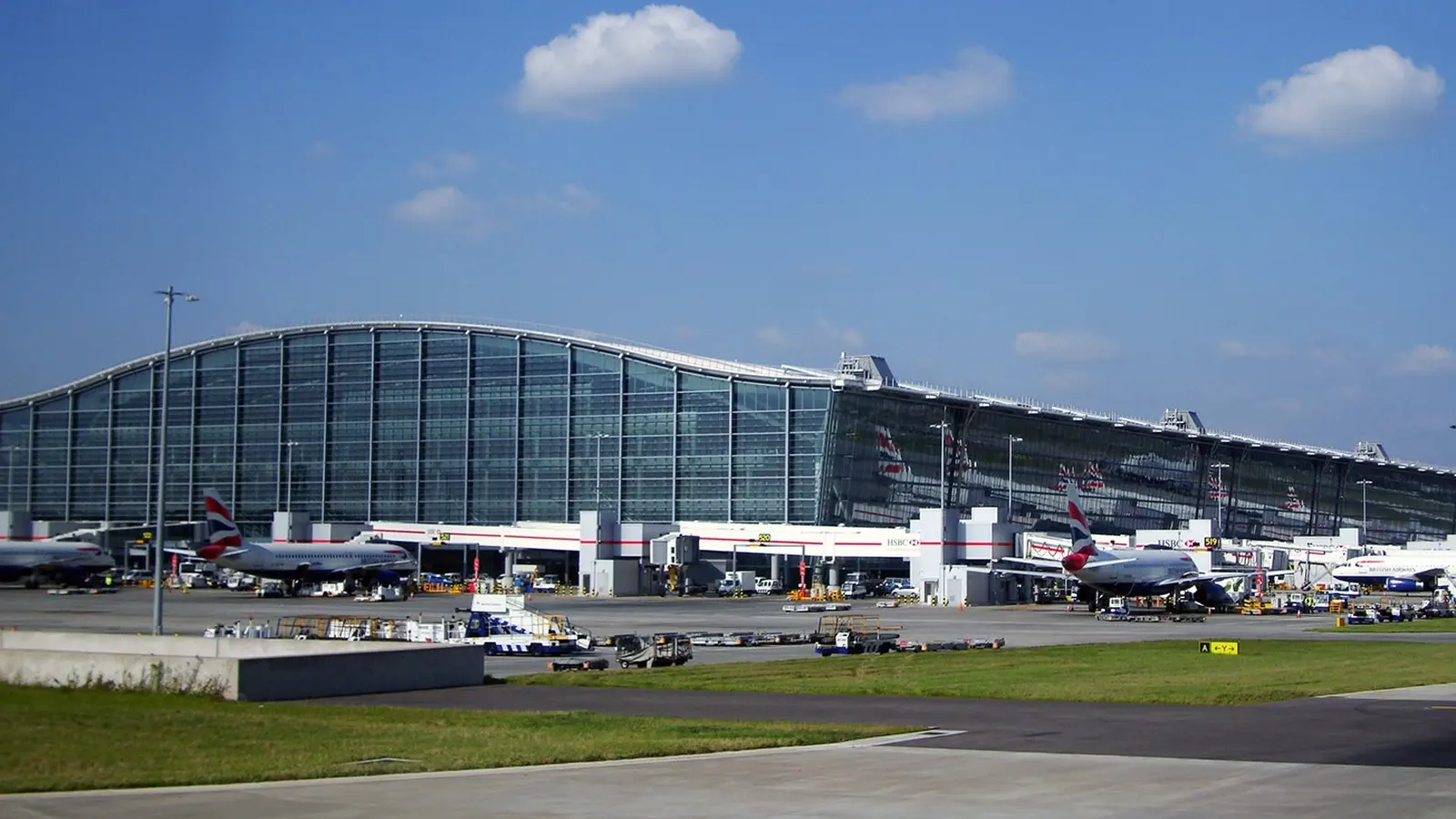
Heathrow Airport Terminal 5 · Photo: Warren Rohner, CC BY-SA 2.0 via Wikimedia Commons
Your flight
When you must leave the Wharf
What each mode offers at that hour
The 7am European hop
~05:00–05:15
Weekday rail is only just stirring and Sunday's starts later still; the pre-booked car was confirmed to a named driver the night before and idles at the lobby on time
The 8–9am long-haul
~05:30–06:15
The first practical trains now exist — but so does the Limehouse Link's building peak; the car leaves earlier than instinct suggests, with the buffer already inside the pickup time
The mid-morning departure
~07:30–09:00
Rail's honest window opens — and if you're solo, light and bound for T2/3 or T4, we'll tell you to consider it; the car's case here is luggage, company and the calls you need to make
The red-eye home, landing 05:30–07:00
—
Arrivals before the city wakes: the tracked car with a name board versus a platform, a lift queue and a district still asleep — the return leg is where this route's regulars stopped experimenting
The sentence that sells the corridor honestly: Canary Wharf's aviation day starts around two hours before its railway's — and a district that flies at five needs a mode that exists at five. That's not marketing; it's the timetable. Send your flight number and building to the desk and the exact pickup comes back computed, buffered and owned.
The Elizabeth Line, Credited Honestly · Then the Asterisks
The purple line is good here — and it carries three catches nobody prints
We keep our honesty even when it costs us fares: the Elizabeth line transformed this journey for a specific kind of traveller. Here's the full credit, and then the fine print that decides who that traveller actually is.
The genuine credit
Direct and quick: Canary Wharf to Terminals 2&3 and Terminal 4 without a change, around 45 to 52 minutes — for a solo mid-morning traveller with one bag, honestly decent.
Frequent once running: daytime services come thick and fast, and the trains themselves are modern and luggage-tolerant by tube standards.
Fair value solo: one traveller, one ticket — the arithmetic works until passengers multiply or the hour turns hostile.
The three asterisks
The waking hour: weekday services begin around 5:30am — after this district's biggest departure wave has already needed to leave. The corridor's core traffic simply predates its railway.
The Terminal 5 branch trap: the direct T5 trains run via the Stratford branch, not through Canary Wharf — a T5 flyer from the Wharf changes trains, cases in hand, against a bag-drop clock. Almost nobody discovers this before the platform does it to them.
The working-traveller tax: a deep station, lift queues with luggage, and fifty minutes in a carriage where the call you need to make — the one with numbers in it — cannot lawfully-in-conscience happen. The car is a rolling office; the train is a quiet zone with your deal on hold.
Our straight rule for this corridor: mid-morning, solo, one bag, T2/3 or T4 — take the purple line with our blessing. Before six, after nine, any group, any real luggage, any T5 flight, or any journey where the hour in transit needs to be an hour of work — the fixed-fare car isn't the indulgent option; it's the only one that matches the brief.
The Crossing · 22 Miles, Three Deciding Junctions
East to west across the whole capital — how the run is actually driven
E14 to TW6 traverses London at its full width, and the journey's fate is decided at three known points. Our drivers treat them the way the towers treat market opens: watched, timed, never assumed.
Stage
The road
The read
1 · Out of the estate
Tower lobby → Limehouse Link
The estate's own circuit to the tunnel — two minutes when clear, and the first place the morning peak bites: the Link's western exit thickens sharply from half six
2 · The eastern approach
The Highway → Tower
Wapping and the Tower passed on the river's line — smooth pre-dawn, watched in daylight
3 · The central choice
Embankment line vs the northern arc
Through-city on the river and Cromwell Road, or swing the arc when the centre argues — the decision made from live feeds at the wheel, not from habit
4 · The western run
A4 → elevated M4
Hammersmith's stretch behaves except in school hours; the elevated section flows until an incident makes it a shelf — both monitored before commitment
5 · The spur & your terminal
M4 → T2/3, T4 or T5
Straight to your airline's own kerb — T5 exactly as directly as any other, no branch changes, no asterisks
The honest clock: pre-dawn and late evening, the crossing runs 35 to 45 minutes and feels absurdly easy; the daytime range is 50 to 80 with the three junctions doing the deciding. Zone charges for the daytime through-city line are already inside your fixed fare — the route is chosen for speed, never to protect a surcharge, because there isn't one.
The Estate & Its Edges · Pickup Geography Done Properly
Every corner of E14 — collected the way the district works
Canary Wharf isn't an address; it's a vertical city with its own circulation rules. Collections here are a craft of lobbies, concierges and timing — and the surrounding streets have their own logic too.
Where you are
How the pickup works
The Canada Square & bank towers
Lobby-coordinated: the driver's approach is messaged, the concierge alerted, and you leave the lift as the car reaches the correct entrance — chosen by building, not guessed
Wood Wharf & the new quarter
The estate's newest circulation, driven weekly — residential towers and offices alike, met at the right door of buildings the sat-navs still misread
South Quay, Heron Quays & Crossharbour
The Isle of Dogs' residential forest — apartment receptions and dock-side entrances, with the estate's one-ways navigated from knowledge
West India Quay & the hotels
Checkout-hour collections at the district's hotels, luggage handled kerb-to-boot, timed to flight rather than checkout queue
Limehouse, Poplar & Blackwall
The estate's edges on the same footing — terraces, new builds and the basin, each quoted from the true address
Wapping & the river fringe
The cobbled streets west of the Link — collected door-exact on the way to the crossing they sit beside
Why the lobby detail matters: at 5am in January, the difference between a pin dropped "near" your tower and a driver at the correct entrance of the correct building is the difference between starting your trip dry and starting it furious. We treat the last hundred metres as part of the service because in a vertical district, it is the service.
Real Problems · Real Fixes
Where Wharf-to-Heathrow journeys fail — and the engineering against each
This corridor's failure modes are as predictable as its schedules. Each is met before your alarm goes off.
RISK / 01
The pre-rail departure
The problem: the 7am wave needs 5am starts, when the railway hasn't opened and app maps over the estate sit thin — the district's busiest travel hour is its least served. Our fix: your car is allocated to a specific driver overnight and rolls out with time to spare; the small hours over E14 are this desk's home fixture.
RISK / 02
The Terminal 5 platform surprise
The problem: discovering at Canary Wharf station that the direct T5 trains run via Stratford — a change with cases inserted exactly where the margin was thinnest. Our fix: the car goes to T5 as directly as to any terminal; the branch map is our problem to know, and now you know it too.
RISK / 03
The call that can't wait
The problem: fifty minutes of transit before an 11-hour flight is prime prep time — and a public carriage is no place for numbers, names or negotiations. Our fix: the car is a private office with a driver: calls made, documents read, the pitch rehearsed — the journey working for you instead of merely moving you.
RISK / 04
The Limehouse window
The problem: the Link's exit congests sharply through the morning build, and a departure planned on the midnight-empty drive time meets the 7am reality. Our fix: pickup times are computed against the window you'll actually travel in, junction buffers included — the flattering number is never the planning number.
RISK / 05
The relocation-scale luggage
The problem: secondments end, postings begin, and a life's cases meet a saloon booked on headcount — or worse, a train's lift queue. Our fix: bags declared at booking, the vehicle sized to match through MPVs and 8/9-seaters, one journey for everything and everyone.
RISK / 06
The red-eye return gamble
The problem: landing at six after a night in the air, into a terminal queue and an unbooked onward leg — the worst hour to improvise. Our fix: book the return with the outbound: the inbound is tracked from take-off, the name board waits in your terminal, and the car home to the Wharf inherits the fixed price automatically.
Who Rides This Corridor
The four travel diaries of the Wharf
RUN / A
The dawn long-haulers
The towers' working travellers on the early transatlantics and Gulf departures — lobby-collected at five, calls made en route, receipted for the expense system, and delivered to T5 or T3 with the buffer a working trip demands.
RUN / B
The visiting delegations
Inbound teams and clients landing for meetings on the estate — met at Heathrow with a name board, driven to the correct tower's correct entrance, and returned to their evening flights with the day's schedule intact at both ends.
RUN / C
The residents' departures
The Isle of Dogs' tens of thousands of tower-dwellers on holidays, visits home and family trips — full-luggage journeys from South Quay and Crossharbour where one right-sized car at one fixed price beats every combination of lifts, platforms and goodwill.
RUN / D
The postings & the students
Secondments arriving with everything they own, placements ending the same way, and the district's student population moving with the academic tide — relocation-scale runs, sized honestly and driven kindly.
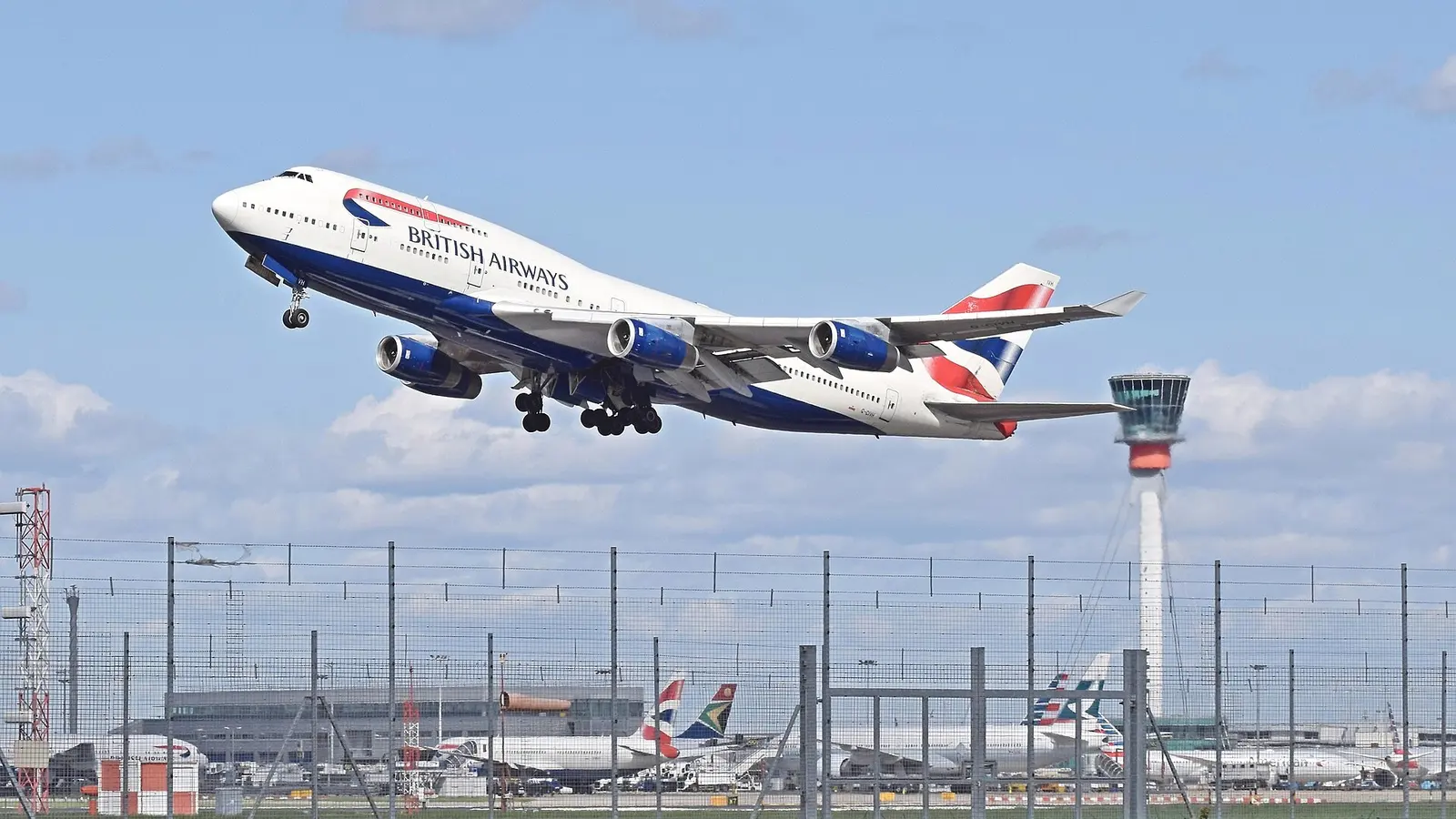
Aircraft landing at Heathrow · Photo via Wikimedia Commons (public domain)
Your Rights · Accountability at Corporate Standard
Licensed, pre-booked, fixed — vetted to the standard this district audits at
A postcode that runs on compliance should recognise the framework instantly: every journey here operates under London's private hire law, and every layer of it works for the passenger.
The regulatory layer
The booking requirement: London's rules recognise private hire journeys only when a licensed operator has logged the booking — which turns your transfer into a recorded engagement, driver attached, well before the morning it serves.
Triple licensing: operator, driver and vehicle each separately licensed, checked and inspected — due diligence performed upstream, verifiable on request.
Insurance in force: hire-and-reward cover attaching to the lawful booking for the full crossing — the clause that matters precisely when nothing else does.
The service layer
Price certainty in writing: fixed at booking, 30% deposit, zones and fees inside — a number that survives the junctions, the hour and the demand curve untouched.
A desk that keeps market hours and then some:020 8888 9988 staffed by people at every hour, your booking and flight already on their screen.
Receipts and repeatability: documentation the expense system accepts, and the same standard on the fiftieth booking as the first — the definition of a corporate-grade supplier.
Compressed: vetted, insured, price-locked, documented and answerable — the same properties this district demands of every counterparty, applied to the 22 miles between your lobby and your gate.
Straight Answers
Canary Wharf to Heathrow — every real question, answered straight
How long does a Canary Wharf to Heathrow taxi actually take?
The crossing spans 21 to 23 miles — London at its full width — and the hour decides everything: 35 to 45 minutes pre-dawn and late evening, 50 to 80 through the working day. Three junctions do the deciding: the Limehouse Link's exit in the morning build, the Hammersmith stretch in school hours, and the elevated M4's approach in any peak. We plan against the window you'll actually travel in, with those buffers inside the pickup time we give you — and since most of this corridor's traffic moves before six, most of its journeys run at the fast end.
Taxi or transfer — which am I booking, and does it matter?
Functionally the same thing done properly: "transfer" is the pre-booked, fixed-price version of a taxi journey, carried out under London's private hire rules — booked through a licensed operator, priced before travel, immune to meters and surge. What you're booking here is that: a fixed fare from your E14 address to your exact terminal, deposit-secured, with the congestion zone, emissions compliance and Heathrow's forecourt fee already inside the number. The word on the confirmation matters less than the number on it — and ours doesn't move.
Honestly, when should I just take the Elizabeth line instead?
Mid-morning or afternoon, travelling alone, one manageable bag, flying from Terminal 2, 3 or 4 — take it, sincerely; it's direct and quick once it's awake. Book the car when any of these is true: your flight needs a pre-6am start (the railway's weekday services begin around half five — after the district's biggest wave must leave), you're bound for Terminal 5 (the direct T5 trains run via Stratford, not the Wharf — you'd change with cases), you're a group or carrying real luggage, or the hour in transit needs to be an hour of calls and preparation. Most of this corridor's bookings tick the first box alone.
How does the lobby pickup work in a district of towers?
Like a meeting, not a scavenger hunt. Your booking carries the building, not just the street; the driver approaches the correct entrance — Canada Square, Wood Wharf, South Quay, wherever — and you're messaged as the car arrives so the lift ride and the pull-up coincide. Concierge desks are looped in where buildings prefer it. At five on a winter morning, that choreography is the difference between a smooth start and a cold, luggage-laden search — which is why we treat it as part of the fare, not a favour.
What does it cost, and what's included?
A single settled figure shown before you commit, spanning the entire journey: luggage, the congestion zone on daytime through-city routings, emissions compliance, and Heathrow's drop-off fee — nothing reappears afterwards as an extra. A 30% deposit secures the booking and the balance settles on the day; a weekend peak (+10%) or the late-night London discount (−£11.55) auto-applies where relevant, shown before you confirm. No meter runs through the junctions and nothing surges at five — the confirmation figure is the transaction's last word.
Do you cover Heathrow back to Canary Wharf, and the rest of London?
Both, daily. The return is the corridor's other half — red-eyes tracked from take-off, a name board in your terminal, the car to the Wharf inheriting the fixed price when you book the legs together. And the wider network is written up in full: the London transfer flagship covers all six airports and every quarter, the Heathrow–central London guides handle the West End side, and the desk on 020 8888 9988, WhatsApp or email handles everything, around the clock.
E14 → LHR · Built for the District's Real Hours
Your flights leave at dawn. So do we.
Lobby-met before the city wakes, the crossing read junction by junction, Terminal 5 without the branch trap, and a fixed fare with every zone and fee already inside — Canary Wharf to Heathrow, run to the Wharf's clock.