Get London Transfer Ltd is a TfL licensed private hire operator - London private hire operator licence number 11588. getlondontransfer.co.uk and rushxo.com are trading names of Get London Transfer Ltd, and rushxo.co.uk is the UK site of rushxo.com. Every booking made on these websites is operated by Get London Transfer Ltd.
Gatwick → Stansted · ~72 Miles · London's Widest Airport Pairing · Fixed Fare
Your Gatwick to Stansted taxi — one car across the gap the network never bridged.
Landing at Gatwick Airport? Let us take the stress off
Your driver is waiting with a name board the moment you come through customs into arrivals – not in a car park, not on the phone. We track the flight, so a late landing costs you nothing, and the first 60 minutes after the plane lands are free waiting time. Luggage trolleys, a child seat, a wheelchair-friendly car: tell us when you book and it is ready.
SIM card and money on the way. Still carrying your own currency? That is fine: every car takes cards and contactless, so you need no pounds in hand for the journey. If you want a UK SIM or some cash, say so and your driver will point you to the kiosks in arrivals (SIM cards: WHSmith and Sim Local in both terminals’ arrivals; currency: Travelex / Moneycorp desks landside in North and South) or, usually cheaper, stop at a supermarket, Post Office or bank on the route. Our local drivers know where the fair rates and the working cash machines are – trust them to sort it in minutes.
Disabled-friendly arrival.Special assistance: Book via airline at least 48h ahead; Assisted Travel receptions at drop-off points, help points at bus stops, entrances, Short Stay car parks, check-in, pre-security and departure lounge; Eagle Hoist with 24h notice. Step-free: Most gates via airbridges; Ambulift where stairs; lifts to station platforms; Premium car parks same-level access. Guide & assistance dogs: Only assistance dogs allowed in terminals; notify airline 48h; Service Animal Spend Area via the Assisted Travel team. Pets: Dogs flying must meet the PETS scheme. Airport accessibility page Our driver meets you at the assistance desk if you prefer, carries folding wheelchairs and walkers free, and assistance dogs always travel with you at no charge.
Get an Instant Quote
🦉Tripadvisor Travelers' Choice 2025Excellent★★★★★★ Trusted24/7 UK Support
Look at the map and you'll see the problem whole: Gatwick guards London's southern approaches from Surrey, Stansted its north-eastern ones from Essex, and between them lies the entire capital plus seventy-two motorway miles of M25. Nobody ever built the link — no direct train has ever existed (the rail version is a three-train chain through central London with your cases hauled on and off at every step), and the coach options wander the long way round via Heathrow or Victoria in three hours and change. Which leaves exactly one single-seat answer: the pre-booked, fixed-fare car — 1h20 to 2h on the orbital, the two great M25 arcs chosen live by your driver, the Dartford charge already inside the number, and both your flights tracked when the journey is a connection. Budget-airline self-connectors, cruise-and-fly itineraries, families mid-relocation and crews mid-rotation: this page is the whole corridor, told straight, with the buffer arithmetic no booking site shows you. The desk runs all night on 020 8888 9988 — because this run's best hours are the ones the timetables sleep through.
Seventy-two miles the network forgot — driven daily by the desk that didn't.
The Two Arcs · The Decision Nobody Else Explains
East through the tunnels or west over the shoulder — how your driver picks the M25's better half
Every Gatwick–Stansted run faces one strategic choice at the M23's end: which half of the orbital to ride. Both arcs work; neither is always right; and the difference between a good hour and a bad one lives in choosing correctly on the day. Here's the decision, laid open:
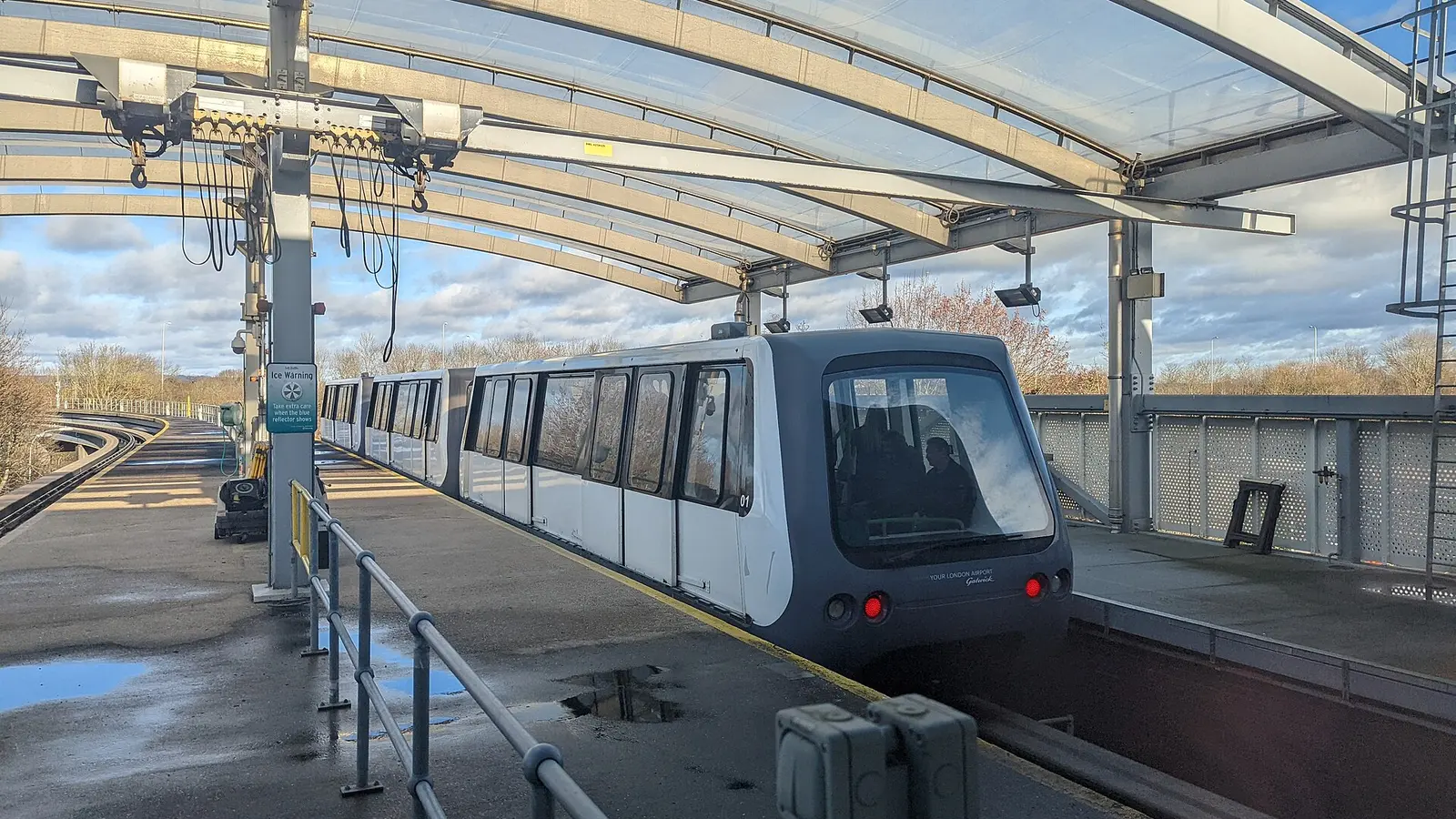
Gatwick Airport · Photo: David Wheatley, CC BY-SA 4.0 via Wikimedia Commons
The eastern arc — via the Dartford tunnels
The western arc — over the Heathrow shoulder
The shape of it
M23 up, then the orbital's right-hand side through Kent, under the Thames at Dartford, and up the Essex flank to the M11
M23 up, then the left-hand side past the Heathrow and Watford quadrants, round the top and down to the M11
Its best self
The shorter road by a healthy margin — off-peak and overnight it's the obvious winner, humming along in well under ninety minutes
Steadier under pressure: more lanes for more of the way, and no single point of failure to fear
Its failure mode
The Crossing itself — one incident at the tunnels and the whole arc stacks; peak hours treat it as a bottleneck by appointment
The extra mileage is permanent, and the Heathrow and M1 quadrants run their own rush hours
When we choose it
Nights, Sundays, clean traffic screens — most runs, most of the time
The moment the Dartford feeds glow red, or when planned works are chewing the eastern flank
What it costs you
Nothing extra — the crossing charge is already inside your fixed fare
Nothing extra — the fare is identical whichever arc wins the day
The point of showing you this: a metered ride profits from the slow road and an app reprices mid-crisis — only a fixed fare makes the routing decision purely about your clock. Your driver reads both arcs live before committing at the fork, and the number on your confirmation doesn't care which one wins. That alignment of interests is the entire product.
Every Way Across · The Honest Comparison
Three trains, a wandering coach, or one car — the full menu, priced in effort
Our habit of crediting the alternatives continues — this corridor just gives them less to work with than anywhere else on our map. Each option, told as it really is:
The option
How it actually goes
The honest verdict
The three-train chain
Gatwick Express to Victoria (~30 min) → Victoria line to Tottenham Hale (~20 min) → Stansted Express (~36 min) — plus two station transits with everything you own
Best case around 1h35–2h and honestly workable for one light traveller with time to spare; the cases come on and off three times, and every change is a place for the plan to wobble
The coach options
No true direct service anymore — routings swing via Heathrow or central London, three hours and change when the connections line up
The budget floor, fairly won — if the clock genuinely doesn't matter and the bags are few, it earns its fare; as a flight connection, it's a gamble we wouldn't take with your ticket
The fixed-fare car
Kerb to kerb on the orbital, 1h20–2h by day and nearer 1h10 at night, arc chosen live, toll inside, both flights tracked
The only single-seat link between these airports — and once two or more travel together, usually the sensible money as well as the calm one
The pattern to notice: on most corridors we can honestly say "the train sometimes wins." Here, the network simply never showed up — no direct rail was ever built and the direct coach has faded away — so the comparison isn't car-versus-train; it's one seat versus a relay. That's not our marketing; it's the timetable's confession.
The Self-Connect Sum · Flight-to-Flight, Done as Arithmetic
Landing at Gatwick, flying from Stansted — the buffer maths that saves the trip
This corridor's signature traveller is the self-connector: two budget tickets, two airlines, zero protection between them. Miss the second flight and nobody owes you anything — so the gap between flights isn't a detail; it's the whole plan. Here's the sum, in the open:
What eats your window
The Gatwick end: taxi to stand, passport queues on the wrong night, and bag reclaim's own sweet time — commonly 45 to 75 minutes from wheels-down to kerbside.
The crossing itself: 1h20 to 2h on the orbital depending on the hour — with the arcs chosen to protect exactly this number.
The Stansted end: bag-drop cutoffs that respect nobody, and security queues built for a fortress of early flights — arrive with the margin the airline's small print demands.
How we underwrite it
The five-hour rule: between scheduled landing and scheduled take-off, treat 4.5 to 5 hours as the floor and more as wisdom — the industry's own guidance for this exact pairing, and ours.
Both flights on one screen: your inbound is tracked from origin so the pickup re-times itself, and your outbound's cutoff sits in the same booking — the driver is briefed on the whole connection, not half of it.
The pre-purchase verdict: message the desk both flight numbers before you buy the tickets and we'll grade the gap plainly — roomy, workable, or a rebooking waiting to happen. Free, fast, and occasionally the most valuable thing on this page.
The overnight version: a late Gatwick landing feeding a dawn Stansted departure is this run at its best — the night orbital drops the crossing toward seventy minutes, an airport-hotel stop at either end slots into the same booking, and the 3am leg is confirmed to a named driver before your first flight even boards. The connection the network never built, running smoothest while the network sleeps.
View from an aircraft window above the clouds
Real Problems · Real Fixes
Where Gatwick–Stansted journeys break — and the engineering against each
Seventy-two miles and two airports give this corridor a rich catalogue of failure. Each entry below is answered structurally, before your first boarding pass prints.
RISK / 01
The connection nobody protects
The problem: two separate tickets mean a missed second flight is entirely your loss — and most travellers discover the stakes only when the first flight slips. Our fix: the five-hour rule, both flights tracked in one booking, and the honest pre-purchase verdict on your gap before money changes hands.
RISK / 02
The Dartford ambush
The problem: the shorter arc's single point of failure can add an hour without warning, and a route locked in by habit rides straight into it. Our fix: the fork is decided from live screens on every single run — and because the fare is fixed, the switch to the western arc costs you nothing but the miles.
RISK / 03
The three-haul relay
The problem: the rail chain's real price isn't the ticket — it's lifting a family's luggage on and off three trains through two of London's busiest interchanges. Our fix: the boot swallows the bags at Gatwick's kerb and opens at Stansted's; between those moments, your hands are free.
RISK / 04
The dawn-fortress start
The problem: Stansted's cheapest departures cluster brutally early, demanding a Gatwick-side start no public option serves. Our fix: the small hours are this run's finest — driver named the evening before, orbital empty, the crossing done in barely seventy minutes while the first trains are still in their depots.
RISK / 05
The group's multiplying tickets
The problem: the rail relay prices per head and per express, and a family of four watches the "cheap" option quietly triple. Our fix: one sealed fare for the whole vehicle — split four ways it routinely embarrasses the relay, and the MPV or 8/9-seater is quoted upfront when the party needs it.
RISK / 06
The mid-journey repricing
The problem: apps re-quote when the orbital misbehaves and meters monetise every stationary minute — seventy-two miles of exposure to someone else's pricing mood. Our fix: the number was sealed at booking with the toll inside; the M25's bad day is our operational problem and never your financial one.
Straight Answers
Gatwick to Stansted — the answers this crossing actually needs
How long does Gatwick to Stansted really take by taxi?
Plan on 1 hour 20 to 2 hours kerb to kerb for the ~72 motorway miles, with the night runs dipping toward 1 hour 10 as the orbital empties. The spread isn't vagueness — it's the M25 being the M25 — and it's exactly why the two-arcs decision above exists: the eastern arc through the Dartford tunnels is the shorter road most hours, the western arc over the Heathrow shoulder is the insurance policy when the Crossing misbehaves, and your driver commits from live screens rather than habit. Whichever arc wins, your fare was already settled.
What's genuinely the cheapest way between these airports?
For one traveller with light bags and a loose schedule: the coach options, honestly — three hours and change the long way round, but the fares are the floor of this market and we won't pretend otherwise. The rail chain lands in the middle on money and effort: quicker than the coach but three trains, two changes and every case lifted three times. The car's honest claim is different: it's the only single-seat crossing that exists, and the moment two or more people travel — or a flight connection is at stake — the one-vehicle fare split between seats usually beats the relay on price as well as everything else. Send your party size and we'll do that sum for you straight.
Can you handle a flight-to-flight connection safely?
It's this route's specialist discipline. Both flight numbers go into one booking: your Gatwick arrival is tracked from its origin airport so the pickup re-times itself around delays, the driver is briefed on your Stansted cutoff rather than just an address, and the desk watches the whole connection as a single job. Before you even buy the tickets, message us the pair and we'll grade the gap — roomy, workable, or rebook — against the five-hour rule. The graders' honest streak matters here: we have talked people out of connections, and those people came back.
Do you cover both Gatwick terminals and meet inside arrivals?
Both terminals, met properly: the driver stands inside your arrivals hall — North or South, whichever your flight actually uses — with a name board, waiting time linked to the delay we can see, and the Stansted end finishes at the set-down closest to your check-in zone. Terminal details are locked at booking so the day itself contains no guessing; if your airline switches terminals late, the tracking catches it and the board moves with you.
What does the fixed fare include on this run?
The crossing entire: the vehicle sized to your declared party and luggage, the arrivals meet, flight tracking with delay-linked free waiting, the Dartford charge for eastern-arc runs, and Gatwick and Stansted's own forecourt fees. A 30% deposit seals the figure, the balance settles on the day, and the two published adjustments — a tenth added at weekend peaks, £11.55 off qualifying late-night London journeys — appear before you confirm, never after. Seventy-two miles is a long way for a number to hold still; ours is built to.
Do you run Stansted to Gatwick, and the other inter-airport links?
Daily in both directions — the reverse run works identically with the arcs mirrored and Stansted's dawn fortress swapped for Gatwick's. The wider inter-airport network is priced and written up across the site: Heathrow ⇄ Gatwick from £125 with published vehicles, Stansted ⇄ Luton from £115, and every airport's own hub via the airport transfers guide. One desk sequences any pairing — 020 8888 9988, WhatsApp or email, around the clock.
Making the Most of Your Journey: Stops & Sightseeing
Eat & shop like a Londoner: fish & chips, roast, afternoon tea, pies, ale, vegan, British brands – with prices (tap to open)
Eat and shop like a Londoner: fish & chips, Sunday roast, full English, afternoon tea, pies, pale ale, vegan & the best British brands
Our drivers get asked for these every day, so here is the shortlist we give in the car. Prices are from the venues’ own menus and booking sites (seen October 2026); tap the Google Maps link for photos, today’s menu and star ratings. Want a stop on the way? Say so when you book and the driver will wait.
Fish & chips
Poppies Fish & Chips Spitalfields E1, Soho W1, Camden NW1, Portobello W11 1950s East End chippy, haddock and cod fried to order, mushy peas cod & chips £21.99, haddock £20.99 (menu) website · photos, menu & ratings on Google Maps
Golden Union Poland St, Soho W1 Proper chippy with a sit-down room, gluten-free batter on request about £15–£19 for fish and chips website · photos, menu & ratings on Google Maps
Sunday roast
Hawksmoor Seven Dials WC2, Borough SE1, Air Street W1, Wood Wharf E14, Knightsbridge The roast most Londoners name first: dry-aged rump, beef-dripping roast potatoes, Yorkshire pudding Sunday roast rump £29.50 (menu); book ahead website · photos, menu & ratings on Google Maps
Blacklock Soho W1, Shoreditch EC2, Covent Garden WC2, Canary Wharf E14 Chop-house roasts with all the trimmings and bottomless gravy roast about £24–£28 (menu) website · photos, menu & ratings on Google Maps
English breakfast
E Pellicci 332 Bethnal Green Rd E2 Family caff since 1900, Art Deco interior, fry-ups and Italian specials; cash-friendly, Mon–Sat mornings full English about £10–£13 website · photos, menu & ratings on Google Maps
The Wolseley 160 Piccadilly W1 Grand café breakfast under chandeliers: the full English, kedgeree, eggs Benedict full English about £20–£24 (menu) website · photos, menu & ratings on Google Maps
Afternoon tea
The Ritz, Palm Court 150 Piccadilly W1 The classic: finger sandwiches, scones, pastries and a pianist; jacket and tie for men, book weeks ahead £85 a head, £105 with Champagne (2026); 12.5% service added website · photos, menu & ratings on Google Maps
Fortnum & Mason, Diamond Jubilee Tea Salon 181 Piccadilly W1 Fortnum’s own teas, a trolley of cakes and the famous scones from £75 a head (2026) website · photos, menu & ratings on Google Maps
Pies
Mother Mash Carnaby St, Soho W1 Pie, mash and gravy or sausage and mash, choose your mash and your gravy pie, mash & gravy from about £15 website · photos, menu & ratings on Google Maps
Pieminister Leather Lane EC1 and across London Award-winning British pies incl. vegan and veggie; takeaway or sit in pie & mash about £12–£15 website · photos, menu & ratings on Google Maps
British pale ale
The Churchill Arms Kensington Church St W8 Flower-covered Fuller’s pub, London Pride on cask, Thai kitchen at the back pint about £6–£7 website · photos, menu & ratings on Google Maps
Ye Olde Cheshire Cheese Fleet St EC4 Rebuilt 1667, Dickens drank here; Samuel Smith’s ales, cellar bars pint about £5–£6 (no cards in some Sam Smith’s pubs – carry cash) website · photos, menu & ratings on Google Maps
Vegan & vegetarian
Mildreds Lexington St, Soho W1 (also Camden, King’s Cross, Dalston, Covent Garden) London’s best-known vegetarian restaurant since 1988, now fully plant-based about £38 a head (TheFork); mains £15–£20 rated 9.3/10 on TheFork, 2,800+ Tripadvisor reviews website · photos, menu & ratings on Google Maps
Fortnum & Mason 181 Piccadilly W1 Tea, biscuits, marmalade and hampers in the famous eau-de-nil tins since 1707 tea caddies from about £10; hampers £50+ website · photos, menu & ratings on Google Maps
Liberty London Regent St W1 Tudor-fronted store for Liberty print scarves, Barbour, Burberry, Mulberry and British designers scarves from about £45 website · photos, menu & ratings on Google Maps
Tipping: 10–12.5% service is often added in restaurants, never in pubs or chippies. Most places take cards; a few old caffs and Sam Smith’s pubs are cash-only. Vegan and gluten-free options are marked on almost every London menu – just ask. The airport shops sell the same tea tins and biscuits at 2–3 times the supermarket price, so buy souvenirs in town.
Seventy-two miles, two arcs read live, the toll inside the fare, both flights on one screen and the buffer maths done before you book — Gatwick to Stansted as a solved problem, at any hour the fortresses fly.