Get London Transfer Ltd is a TfL licensed private hire operator - London private hire operator licence number 11588. getlondontransfer.co.uk and rushxo.com are trading names of Get London Transfer Ltd, and rushxo.co.uk is the UK site of rushxo.com. Every booking made on these websites is operated by Get London Transfer Ltd.
★★★★★ Five stars on Google — including from people we told to take the train instead.
Unlike most routes on this site, this one has an excellent direct train. Great Western runs Oxford to Paddington in around an hour, with the fastest services closer to fifty minutes, several times an hour. The Oxford Tube coach runs to west London 24 hours a day, up to every 10 minutes, from about £15. If you are travelling alone with one bag from near Oxford station to near Paddington, take the train — it is faster and cheaper than we are and we would rather tell you. A car covers the 60 miles in 1h15 to 2h, and earns its fare in a narrow, well-defined set of circumstances set out below.
Oxford to Paddington at a glance
Direct train
yes — GWR
Fastest rail time
~51 min
Typical rail time
~1 hour
Oxford Tube coach
24/7, from ~£15
By car
1h15–2h
Road distance
~60 miles
Car is faster?
no — honestly
Car is better when
see below
Operator times checked 15 August 2026 · confirm with GWR
The one corridor on this site where we will actively point you at the railway — and explain the exceptions.
The Part Most Taxi Pages Leave Out
Should you get the train from Oxford to Paddington instead?
Very often, yes. This corridor is one of the best-served intercity links in England, and writing a page that implied otherwise would be dishonest and would not survive thirty seconds of checking. So here is the comparison as it actually stands.
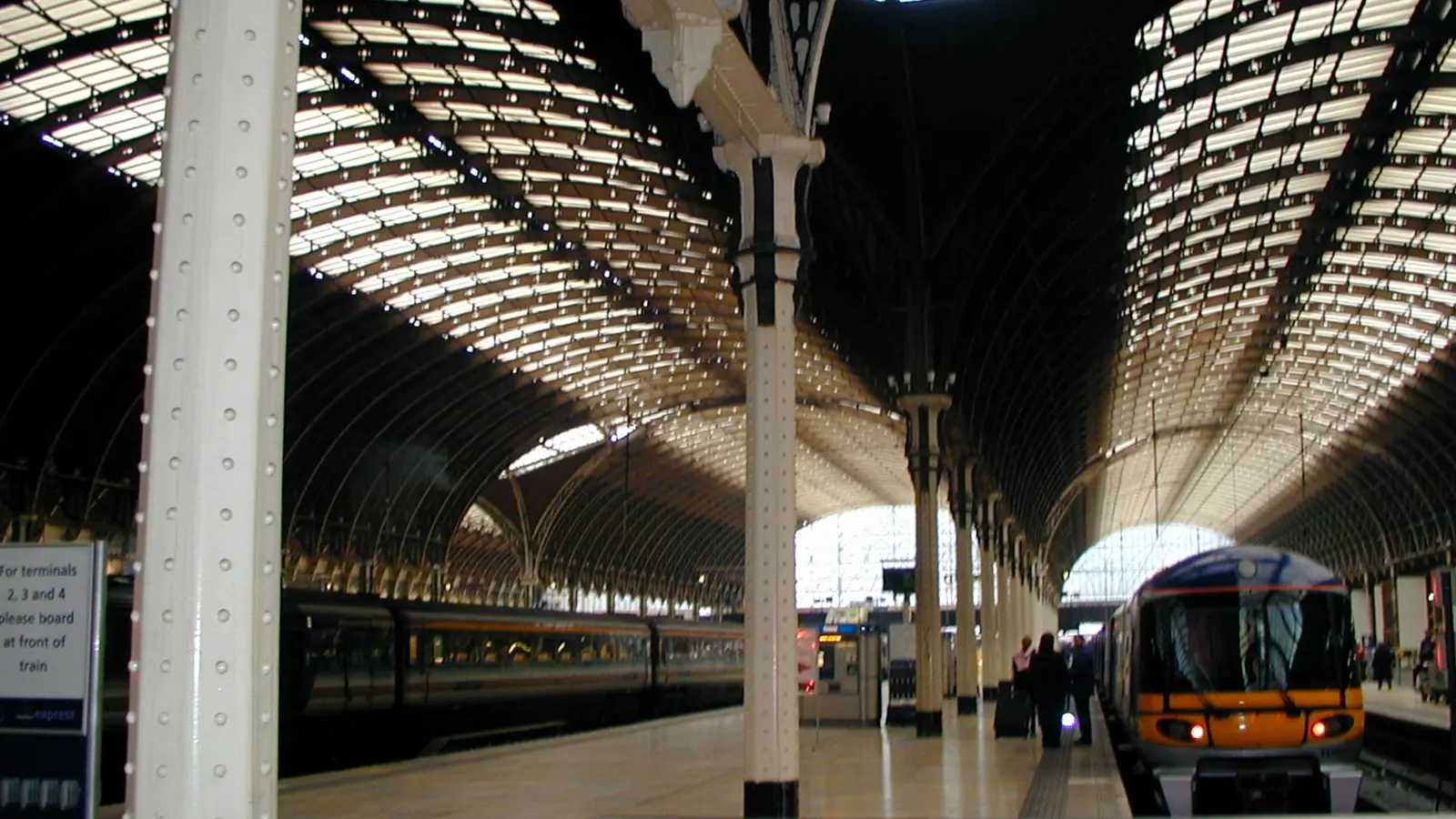
Paddington station · Photo via Wikimedia Commons (public domain)
Oxford to Paddington: train, coach and car compared
Option
Journey time
Rough cost
Honest verdict
GWR direct train
~51 min–1h
Varies; advance is cheap
The default answer. Fast, frequent, and lands you inside Paddington itself. Take it unless something below applies.
Oxford Tube coach
~1h40+
From ~£15
Runs 24 hours, up to every 10 minutes, no peak pricing. Slower, but unbeatable at 03:00 or on a tight budget. Sets down in west London rather than at Paddington itself.
Private car
1h15–2h
Written quote
Slower than rail and dearer than both. Buys door-to-door with no handling, and immunity to timetables. That is the entire value proposition — nothing else.
↔ Swipe the table sideways on mobile
Why we publish this. A customer who books a car for a journey the train does better does not come back. A customer we send to the railway once, honestly, frequently does — for the airport run, the group booking or the Sunday when the line is shut. We would rather be the firm that told you the truth about a fifty-one-minute train.
The Exceptions, Precisely
Six situations where the car genuinely wins
These are not marketing categories. They are the six reasons people actually book this corridor with us, and if none of them describes you, the railway is your answer.
CASE / 01
Engineering closures
The Great Western route between Oxford and London is periodically closed at weekends and over holidays for works, replaced by buses that turn an hour into something much longer. A car is indifferent to whether the line is open, and those are the days our phones ring hardest.
CASE / 02
More people than a taxi at each end
Four to seven travelling together means four to seven rail fares plus a cab at both ends. Split across a single vehicle the arithmetic changes completely, and nobody gets separated across two carriages.
CASE / 03
Luggage that has to be lifted
The train is fine with a cabin bag. It is markedly less fine with a term's belongings, an instrument, exhibition material or three large cases and a pushchair — all of which have to get from an Oxford address to the platform before the fifty-one minutes even start.
CASE / 04
Neither end is near a station
Oxford station sits west of the centre and Paddington is not where most London business happens. If your journey is really Headington to Canary Wharf, the "hour" is the middle third of it and the car is competing on the whole trip rather than the fast bit.
CASE / 05
The hours the railway doesn't cover
Early starts before the first service and returns after the last one are ordinary requests here. The coach covers some of that gap admirably; a car covers all of it, from your door, at a price agreed before the night began.
CASE / 06
A journey that must not fail
A funeral, an interview, a hospital appointment, a connection with no second option. The train is very reliable and occasionally is not, and there are days when paying for certainty is simply the rational choice.
The Thing About Paddington
Paddington is usually a connection, not a destination
Almost nobody's business is at Paddington. It is where you change — onto the Elizabeth line across London, onto the Heathrow Express, or into a cab for the last stretch. Worth deciding whether you actually need the station at all.
What people are usually doing at Paddington, and whether the station is the right target
Your real plan
What Paddington gives you
Is the station the right drop?
Connecting to Heathrow
Heathrow Express or the Elizabeth line west
Often not — a car from Oxford can run straight to the terminal without entering London at all
Crossing to the City or Canary Wharf
The Elizabeth line east
Reasonable if you are light; a single car is simpler with luggage
A meeting in the West End or Mayfair
A short cab or Tube hop
Ask for the final address instead — same fare, one fewer handover
A hotel in Bayswater or Paddington itself
You are already there
Yes — this is the one case where the station genuinely is the destination
↔ Swipe the table sideways on mobile
The question worth asking before you book. If your Oxford journey is really heading to Heathrow, going via Paddington is the long way round — the M40 meets the M25 well west of London and reaches the terminals without touching the city. Our Oxford to Heathrow page covers that properly. Tell the desk the actual endpoint rather than the station you assumed you needed.
If You Are Driving It
What the sixty miles look like when the car is the right call
The route is the M40 to the A40 and in along Westway. Where it differs from a rail journey is that the variability sits at the London end rather than being averaged across the whole trip.
STRETCH / A
Oxford to the motorway
Getting clear of Oxford is its own small journey, and the direction you leave in depends on which side of the city you started. A Botley or Summertown pickup meets the road very differently from a Cowley or Iffley one, which is why the postcode changes the quoted departure time.
STRETCH / B
Westway into Paddington
The final few miles are the ones that decide your arrival time. Approaching Paddington from the elevated A40 is quick when it flows and slow when it does not, and unlike the motorway there is no version of this stretch that avoids London's own traffic.
Practical note on set-down. Paddington's forecourt arrangements are shaped by taxi ranks, bus lanes and access restrictions, so the workable stopping point is not always the one directly outside the entrance you want. Tell the desk which part of the station you need — the Elizabeth line entrance, the Heathrow Express platforms or the Praed Street side — and the approach is chosen for it.
Oxford to Paddington — the questions people actually ask
Is there a direct train from Oxford to Paddington?
Yes — and it is good. Great Western Railway runs direct services between Oxford and London Paddington, typically in about an hour with the fastest closer to fifty-one minutes, several times an hour. This is one of the few routes we cover where the railway is genuinely the better default, and we would rather say that plainly than sell you a slower, dearer journey. Confirm current times and fares with the operator.
So why would anyone book a taxi from Oxford to Paddington?
Six reasons, and they are specific: engineering closures that replace the train with buses, groups of four or more where the per-head maths changes, luggage that has to be lifted onto a platform, journeys where neither end is near a station, hours outside the timetable, and trips that simply must not fail. If none of those describes you, take the train.
How long does the drive from Oxford to Paddington take?
Around 60 miles and typically 1 hour 15 to 2 hours — slower than the train in nearly all conditions. The M40 stretch is quick; the Westway approach into Paddington is where the range widens. We quote against the hour you are actually travelling, and if the number we give you is worse than the train's we will point that out rather than hope you do not notice.
What about the Oxford Tube coach?
Genuinely excellent for what it is. It runs 24 hours a day, up to every ten minutes, with fares from around £15 and no peak pricing, and it stops near Underground entrances in west London rather than at an isolated coach station. For a budget traveller, or anyone moving at three in the morning with a rucksack, it is often the best answer on this whole corridor. It is a poor fit for heavy luggage, small children or a fixed appointment.
The line is closed for engineering this weekend — can you help?
That is one of the clearest cases for booking us. Planned closures on the Great Western route replace trains with buses on exactly the weekends people most want to travel, and our price does not move because the railway is shut. Book ahead when you see a closure announced rather than on the morning, because those are the days demand concentrates.
Can you pick up from anywhere in Oxford, not just the station?
Anywhere with a postcode — colleges, Headington, Summertown, Cowley, Botley, the science parks and the surrounding villages. That is much of the point: if your journey starts a bus ride from Oxford station, the train's fifty-one minutes is only the middle portion of your actual trip, and the comparison changes once the whole journey is counted.
Where exactly do you drop at Paddington?
At the closest permitted point to the entrance you need. Paddington has several, and they are not interchangeable — the Elizabeth line entrance, the Heathrow Express platforms and the Praed Street side involve meaningfully different walks with luggage. Say which service or exit you are heading for at booking and the set-down is planned around it.
Do you run Paddington back to Oxford?
Daily, on its own page: Paddington to Oxford taxi, which covers the last-train problem and Oxford's arrival geography. Book both directions together for one reference and a discount on the return.
OXF → PAD · The Honest Corridor
Usually, take the train. Sometimes, don't.
A fast direct railway runs this route and we are not going to pretend otherwise. When luggage, numbers, engineering works or the hour make it the wrong tool, the car is here — at a written price.